
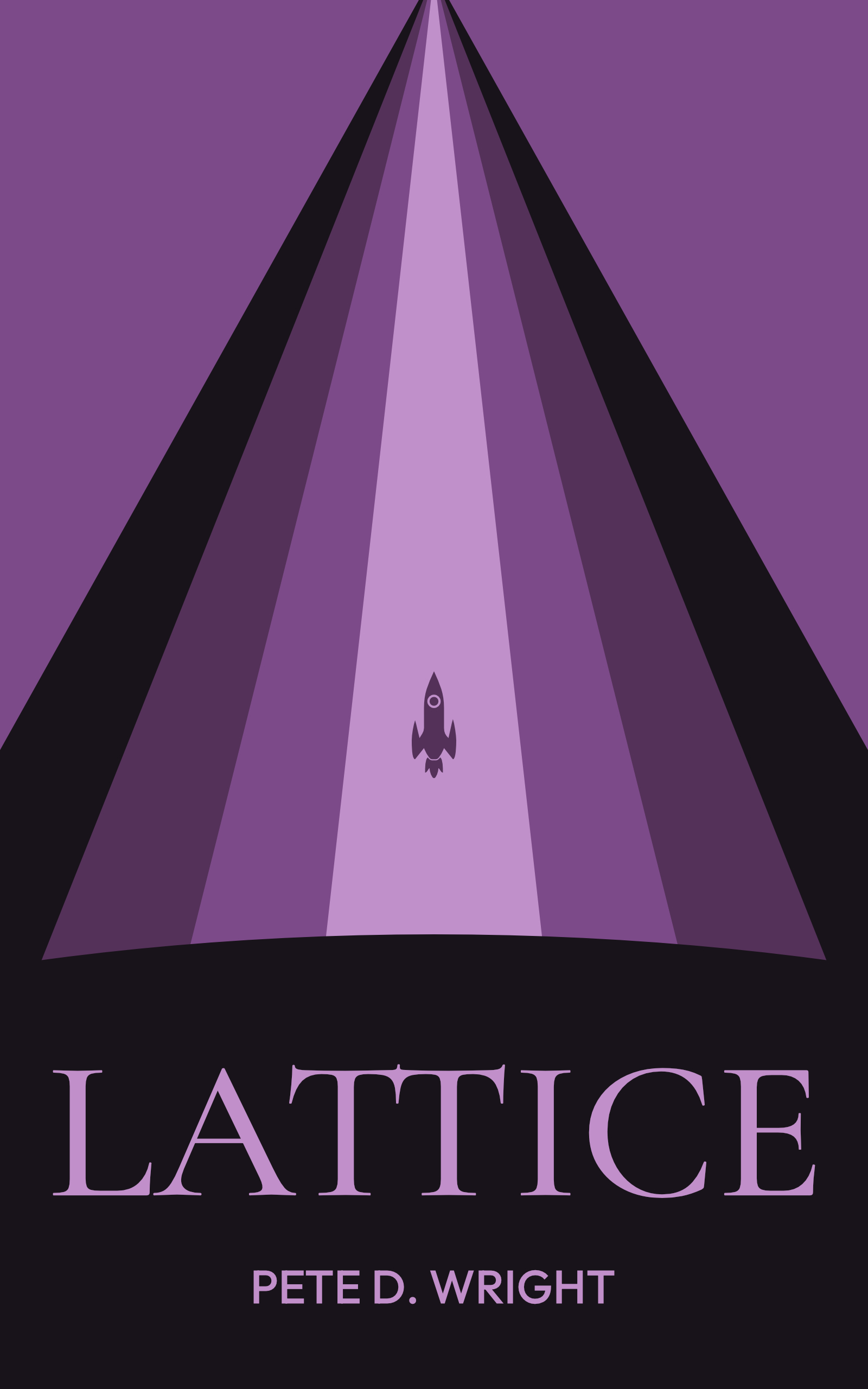
A science fiction novella about the system we'd build if we discovered the worst possible fuel source — and why we'd never shut it down.
Coming April 7, 2026
I wrote Lattice in high school.
Well — I wrote the first version. Six thousand words for Colin Chisholm’s senior creative writing class. Mr. Chisholm was a western romantic, the kind of teacher who made you feel like writing was the most important thing a person could do, and then showed you what it looked like when someone actually did it well. He wrote about the old west, about dust and distance and people who said very little and meant all of it. I adored the guy.
So naturally I handed him a science fiction story.
I don’t remember what I was thinking. I don’t remember the assignment, or the prompt, or what I was reading at the time that made me think a story about people turning to crystal in deep space was the right move for a class taught by a man who probably had a framed map of the Oregon Trail somewhere in his house. But I wrote it. And he liked it. And that was enough to convince me, at seventeen, that I was a fiction writer.
I was not a fiction writer.
I became a podcaster, a film critic, a guy who talks about stories for a living. Two decades of it. Two decades of sitting in front of a microphone and explaining why a scene works, why a character lands, why the third act collapses, why the director should have trusted the audience. I got good at the talking. The writing part — the part where you sit alone in a room and try to make something out of nothing — that I left in the high school file.
The file survived. It moved from a floppy disk to a zip drive to a hard drive to a cloud folder, migrating forward through four decades of storage media the way certain species survive mass extinctions: not through fitness, but through sheer indifference to the odds. I never deleted it. I never opened it either. It just sat there, 6,000 words in a folder I hadn’t clicked on since the Clinton administration.
Then a conversation happened.
I was recording an episode of Craft and Chaos — a podcast about creative work, which is a thing you can apparently make a podcast about — and somebody said something. I don’t even remember what it was. But it knocked loose a memory of a story I’d written a long time ago about a ship and a conspiracy and a man whose body turned to glass. And I thought: huh. I wonder if that file still exists.
It did.
I opened it. I read it. It was — and I say this with the deep affection of a man reading his own teenage prose — not great. The bones were there. The premise held up. But the writing was exactly what you’d expect from a seventeen-year-old who thought adjectives were a competitive sport. The characters talked like they’d swallowed a thesaurus. The science was hand-wavy in places where it needed to be precise and precise in places where nobody asked. The ending was abrupt in the way that high school stories end: not because the story was finished, but because the writer had run out of things to say.
But the bones. The bones were good.
So I did what any reasonable person would do when they find a forty-year-old file on their hard drive: I decided to turn it into a novella and self-publish it on Amazon.
The rewrite took about two months. The original 6,000 words became 30,000. The single storyline became three. Characters who had been sketches became people I had to sit with and figure out. The conspiracy — which in the high school version was basically “bad guys do bad thing” — became a systems argument, a machine that builds itself, a structure nobody can shut down because it works too well. I gave it chapters. I gave it a timeline. I gave it a title that meant something.
I am not going to pretend I knew what I was doing. I’m a guy who has spent twenty years telling other people what works in their stories, and I can report that this expertise is absolutely useless when you’re staring at your own blank page at 11 p.m. trying to figure out why your protagonist won’t do the thing you need him to do. Talking about craft and doing craft are different muscles. I knew that intellectually. Now I know it in my lower back.
The book is called Lattice. It’s about a bail-skip investigator who goes home for the first time in fifteen years and finds out that the people running the galaxy have discovered a new use for the condemned. It’s about systems — the ones we build, the ones we feed, and the ones we can’t shut down because they work too well. It’s about a father, two sons, and the distance between them.
It’s also about a seventeen-year-old who wrote a weird story for a class taught by a man who loved the old west, and a fifty-something who found the file and thought: I think there’s a book in here.
There was.
Lattice is available now. If you read it, thank Mr. Chisholm.