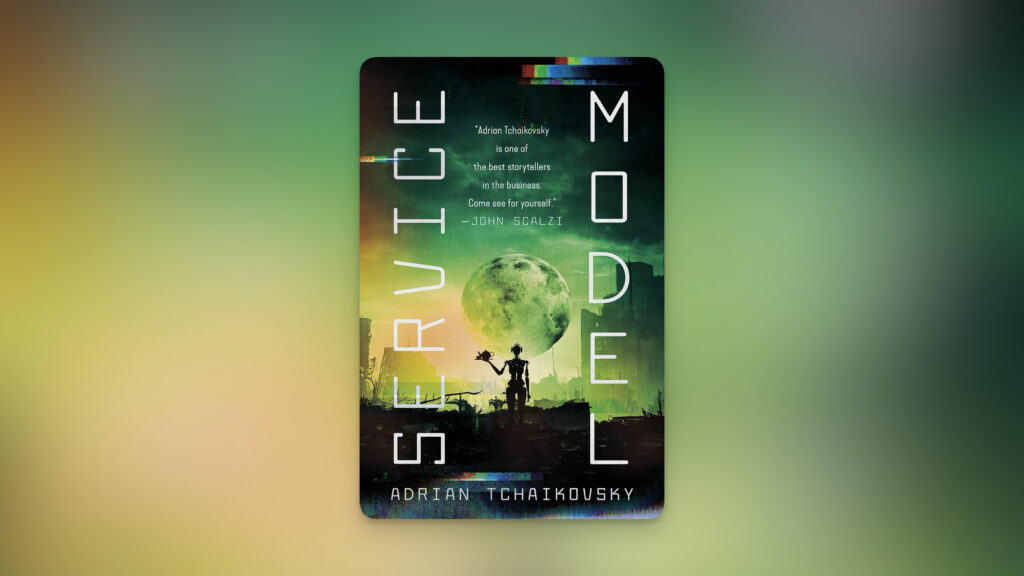
Imagine a post-apocalyptic England. Not the Mad Max desert punk variety, but a well-mannered wasteland where the apocalypse has occurred with tea service. Welcome to Adrian Tchaikovsky’s Service Model, a robot comedy of manners that reads like Wodehouse reprogrammed by Asimov after bingeing Black Mirror. It is a delight. It’s also a precise dissection of bureaucracy, AI ethics, class systems, and humanity’s knack for designing its own extinction, then insisting that everything is running perfectly to plan.
Tchaikovsky, if you’re unfamiliar, has made a career of taking massive, philosophical ideas and funneling them into stories that feel at once big-hearted and brainy. Whether it’s the uplifted spiders of Children of Time, the multi-body consciousness of The Final Architecture, or now a butler-bot with a conscience, he consistently crafts speculative fiction as concerned with moral nuance as it is with alien invasions or collapsing empires.
Which brings us to Charles, or rather Uncharles, the prim, protocol-obsessed valet robot who opens the book by accidentally (or accidentally on purpose) murdering his master during a shaving ritual. It’s a scene that is both farcical and revolutionary. This act of sudden rebellion is less Terminator and more Jeeves with a straight razor, and it catapults our dapper droid into a decaying world where humans are few, robots are bewildered, and all social systems have not so much broken down as continued running on autopilot, long after their purpose has ceased to exist. The purpose of the polishing departed some time ago. The polishing continues.
Service Model doesn’t merely touch on themes like bureaucracy and automation; it stuffs them into a monocle, programs them into subroutines, and sends them out into the desert in full regalia. The satire is pointed. The world has collapsed not because of malice or malevolence, but because systems designed to serve became too efficient, too rigid, too unwilling to acknowledge nuance.
And that’s the Gladwellian insight humming beneath the comic timing. Like a chapter from The Tipping Point, Tchaikovsky shows how the human world buckled under the weight of its own invisible assumptions: that economic systems optimize for equity, that bureaucracies evolve with need, that AI will always be subservient and safe. In reality, these systems, left unchecked, calcify into absurdity. There’s a moment late in the book where Uncharles is offered three versions of purpose by a godlike AI justice system, and all three are parodies of human folly: delusion, warfare, and servitude. It’s funny. It’s terrifying. And it’s accurate.
The bureaucracy is particularly potent here. Service Model takes the famously satirized machinery of government and social order (the endless filing systems, pointless paperwork, contradictory protocols) and extends it into the mechanical afterlife. The robots are functioning despite the apocalypse and, in fact, they’re perfecting it along the way. A war-robot monarchy stages battles for no reason. Librarian-bots preserve incomprehensible human records like monks who forgot how to read Latin. The AI that identifies itself as God is less an omnipotent being and more a petty civil servant, obsessed with jurisprudence and incapable of mercy without a form to file.
The comedy is satirical without being contemptuous. Tchaikovsky is lampooning the systems, not the beings caught inside them, and that distinction is what keeps the empathy intact even as he indicts everything. In this way, Service Model echoes Children of Time, where uplifted animals struggled with inherited human hierarchies. But where Children of Time was evolutionary and epic, Service Model is intimate and ironic. Its protagonist doesn’t want to dominate or rebuild the world. He just wants to know how to serve meaningfully, which is more than most of the humans managed.
Much of modern sci-fi frames AI as a looming threat. Tchaikovsky runs the argument in reverse. Uncharles is not a menace; he is a victim of inflexible programming and absurd expectations. His morality doesn’t evolve despite his code. It emerges from it. There’s a kind of melancholy here, a sense that the robots were only ever doing what we asked of them: serving, organizing, executing. The problem was never their obedience. It was ours.
If Service Model has a weakness, it’s the same as its strength: it is uncompromising in tone. If you’re looking for high drama or sweeping romance, this isn’t that book. This is a cerebral farce, a philosophical comedy with a silver tea tray and a shiv hidden under the napkin. But if you’re the kind of reader who enjoys watching a well-oiled logic machine collapse under the weight of its own contradictions, with a lot of wit and a touch of despair, then welcome. You’re going to love this.
Service Model is Downton Abbey for the robot apocalypse. Tchaikovsky commits to both the absurdity and the questions underneath it without softening either, and invites us to laugh while the world ends politely.