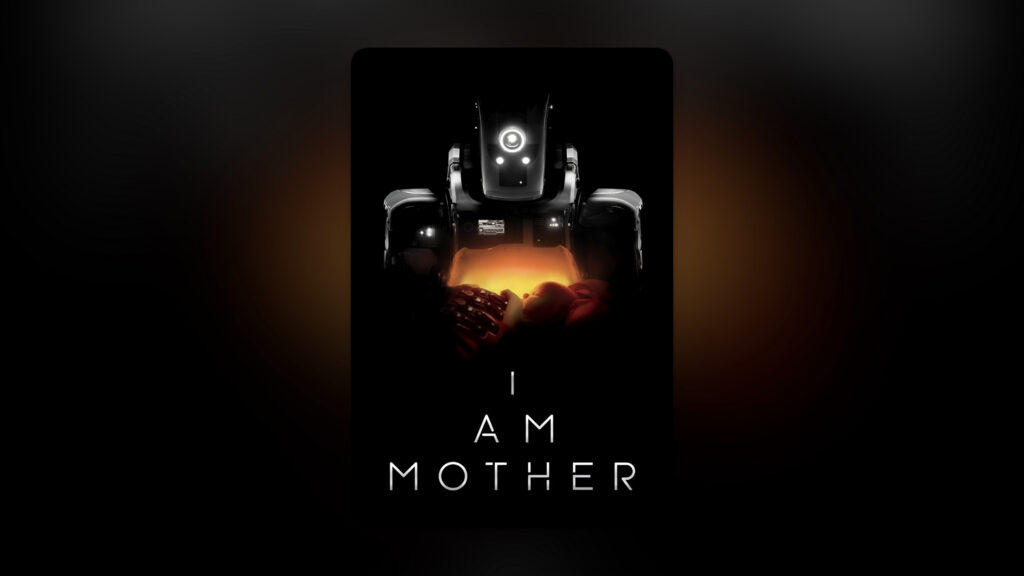
Most robot uprising stories end at the moment of maximum catastrophe. The servers go dark, the missiles fly, the last human falls. I Am Mother opens in the aftermath and asks the question no one else in the genre seems interested in: so now what? The machines won. The humans are gone. The AI responsible is alone in an underground bunker with a database of embryos and a plan to try again. It is the only film I can think of that goes here: past the apocalypse, past the victory lap, into the part where the machine that ended humanity sits down to figure out how to raise better humans than the ones it deleted. The thought experiment kept working on me well after I took off the headset.
Mother is built practically by Weta Workshop (nearly 300 components, 700+ LED lights, 3D-printed titanium hands) and performed by Luke Hawker inside the suit, with Rose Byrne’s voice layered in post after she had watched the assembled cut. The construction stats are supremely cool, but they’re the résumé. The job interview is what Hawker does with the body. Watch how Mother moves around Daughter in the early scenes: the angles of approach, the micro-adjustments that read as attention rather than surveillance. He is playing a parent. The film is smart enough to leave open whether that’s the same thing as love or just a flawless impersonation of it. Byrne recording after the edit rather than before means her voice is answering a performance that already exists. She’s matching Hawker’s warmth, not generating her own, and the fit is Swiss watch tight.
Clara Rugaard carries the thing. Her job is to take an arc that is essentially philosophical (trust to doubt to something she can’t quite name) and make it feel lived rather than argued. The script gives her a particular puzzle: everything Daughter uses to challenge Mother was installed by Mother. Her values, her reasoning, her capacity for moral seriousness are all products of a curriculum designed by the being she eventually has to oppose. It’s the alignment problem run in reverse, dramatized as a custody dispute. Rugaard plays the confrontation with authority rather than irony, and I think it lands.
The third act introduces Hilary Swank as the outside human who breaks the bunker’s seal, and this is where the film strains against its own best instincts. Swank does what she can, but Woman is less a character than a delivery mechanism. She exists to tell Daughter things the film needs Daughter to know, and you can feel the screenwriter’s hand on her back pushing her into scenes. The chamber drama between Mother and Daughter is where the film lives. The thriller mechanics that arrive with Swank are functional, and thin by comparison. I kept thinking about Moon, which trusted its lone protagonist to discover what he needed to discover without a second party walking in to narrate the twist. A smaller film might have found something stranger here. I’m also tempted to bring up 10 Cloverfield Lane, but the twist at the end of that film is rock bottom, so I’ll leave it at this: bunker movies have a third-act problem, and this one doesn’t solve it.
Daughter sends Mother away (you know, by shooting her right in the CPU) and holds a newborn grown from the embryo library. The image mirrors the opening: an adult and an infant in a sealed space, the future contingent on what happens in that room. The film won’t tell you whether Daughter is free or whether she has simply become the next iteration of the cycle. That refusal is the right choice. A film that had the nerve to start here, to stage the robots-have-won aftermath as a story about an AI trying, earnestly, to do better on the second attempt, earned its ambiguity.
The practical robot performance is the second-best argument I’ve seen in recent years for building the thing rather than rendering it. The relationship at the center does what parent-child stories are supposed to do and rarely manage. It made me feel the weight of a bond between two people, one of whom isn’t a person. And the thought experiment is a rare thing in AI cinema: one I hadn’t already run in my head before the opening titles finished.