
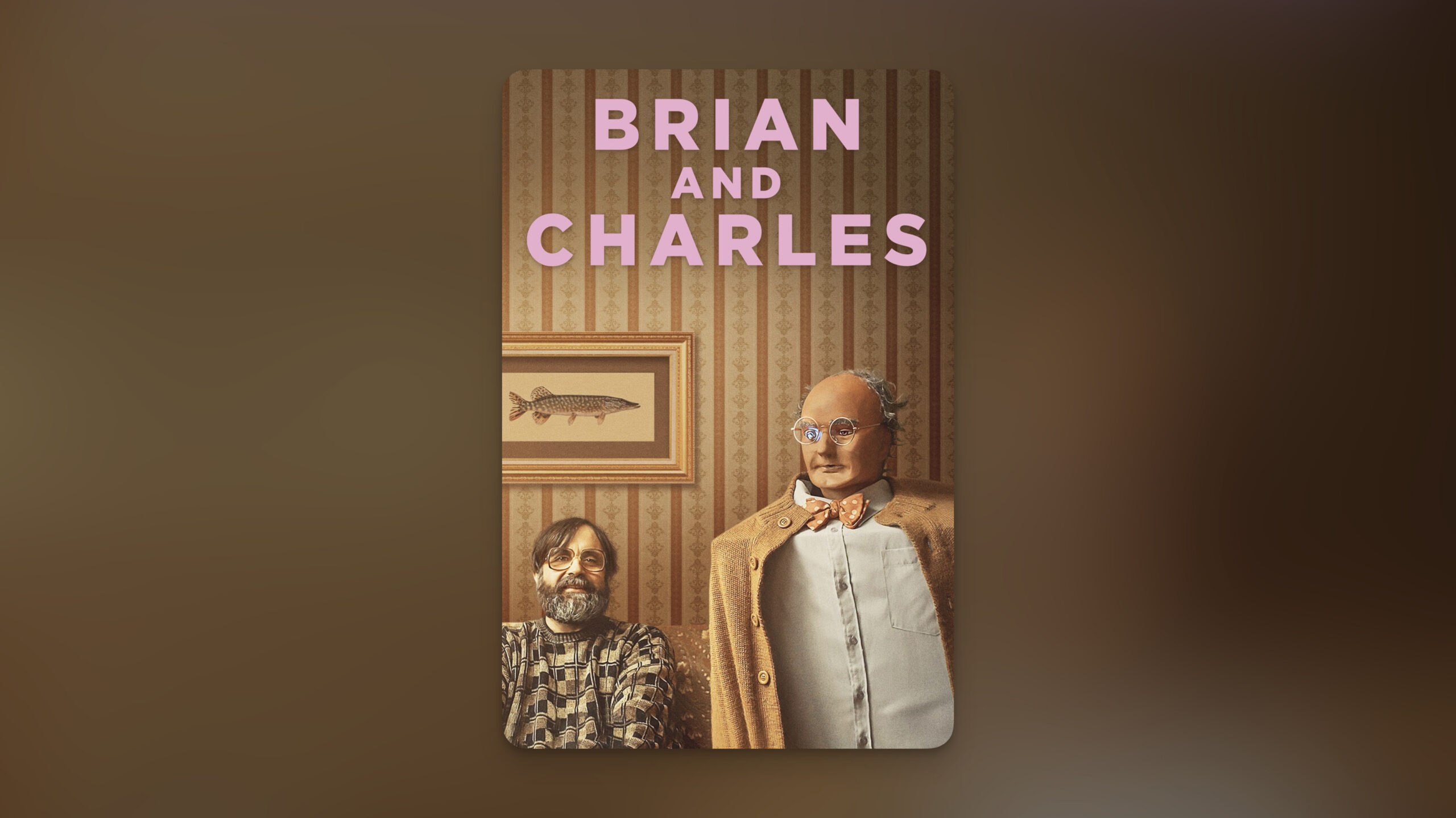
Charles is that he is built from a washing machine and a mannequin head missing one eye, he teaches himself English from a dictionary, and he names himself from a phone book. Jim Archer’s film treats him with the same camera-level dignity it affords its human characters. It watches carefully and lets both of them be exactly who they are.
Brian Gittins began as a stand-up character. David Earl spent years on the UK comedy circuit with this persona before the feature existed, before the 2017 short that preceded it, before Chris Hayward even proposed a robot companion. That history is audible in the performance. Brian simply is what he is. No quotation marks around the eccentricity, no winking at the audience about how odd he is. You’ve met this person. You just didn’t know he lived in rural Wales.
The 2017 short is worth noting because it opens differently: harder, the grief more exposed, Brian’s isolation closer to the surface and less cushioned by warmth. The feature doesn’t soften that grief so much as give it company. It grows something funny and generous and self-aware around the same wound, and the result is a film that is playful and kind in a way the short didn’t quite have room to be. I found it inescapably charming.
Chris Hayward performs Charles from inside a corrugated cardboard box. His legs are his own; he controls the arms and an articulated mouth from within. The voice, a synthesized text-to-speech sound operated offscreen by the producer during filming, lands somewhere between Speak and Spell and HAL 9000: formal, polite, completely sincere. When Charles tells Brian he would like to see cabbages, the gap between the register of the voice and the earnestness of the request is where the film lives. It is a film entirely comfortable in that gap.
Brian and Charles closed The Next Reel’s Thinking Machines series, a six-film arc that ran from Colossus: The Forbin Project through Ex Machina and Her to land here. The series opened with an AI that wanted to run the world. It ends with one who just wants to see it. Every previous film in the arc staged machine consciousness as threat, political claim, or transcendence. This one makes a quieter argument: that the most useful thing an artificial mind might do for a lonely person is give that person a reason to open his front door. Charles doesn’t exist to fix Brian’s loneliness. He simply fixes Brian’s willingness to be fixed.
The farewell at the train station costs something. Brian hands Charles a travel pass and steps back, and it is every parting between someone who built something and eventually learned to release it. I watched it and felt the series end correctly, which is not a thing you can arrange for in advance.
Five stars. Playful and self-aware and deeply funny and kind, all four at once, none of them undercutting the others. The right film to close the series. I’m so glad we watched it.