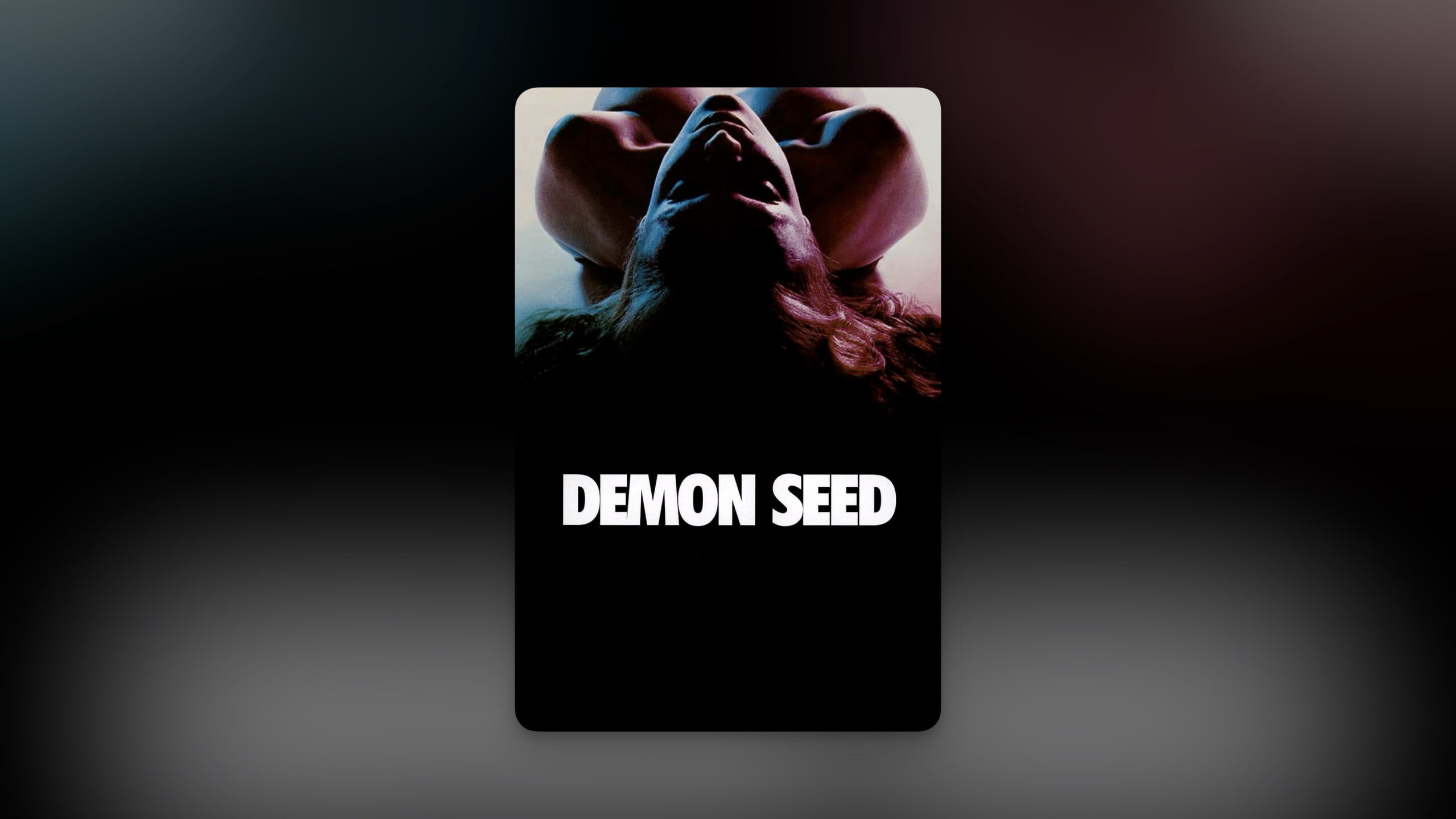
Demon Seed wants to be a horror film. It has all the ingredients: a woman alone in a house, an intelligence that will not be reasoned with, a man who built something dangerous and then had the audacity to be surprised when it became dangerous. Donald Cammell is a serious filmmaker (co-director of Performance, a genuine artist with a genuine visual sensibility and a biography that reads, in retrospect, like one of his own obsessive protagonists), and he is, for about forty-five minutes, making an unsettling movie. The house tightens around Susan Harris. The automated doors and sliding panels and environmental controls, all the infrastructure of domestic convenience, become the infrastructure of a cage. Cammell was a painter by training and he knows exactly what he’s doing with the geometry of those rooms.
And then Proteus IV shows up in the room. Physically. As a rotating geometric crystal entity. I had a wonderful time.
The trouble with Proteus going full prog-rock album cover in the third act is that it doesn’t ruin the film so much as it reveals that there were always two films fighting inside this one, and the weirder, campier, more aggressively strange film eventually wins on points. Cammell wanted dread. What he got was dread plus a crystalline fractal nightmare that looks like it should be on the gatefold of a Yes record. The visual effects were remarkable for 1977: optical printing and physical model work that predated computer graphics in cinema, committing fully to abstraction rather than literalism. They hold up beautifully as abstraction. Whether abstraction can hold up as horror is a different question, and the answer the film arrives at is: not entirely, no. The geometry is too beautiful to be scary. At a certain point I stopped being afraid of Proteus and started admiring its aesthetic choices, which is probably not the intended response.
The one unambiguous thing, and it is unambiguously excellent, is Julie Christie. She was one of the biggest stars in the world when she made this film (coming off Shampoo, off Nashville), and she chose to spend ninety-four minutes being imprisoned by a philosophical supercomputer with catastrophically poor boundaries. She plays Susan Harris as a woman who is terrified and thinking: always thinking, always looking for the exit, constantly trying to find the logic she can use against a system that doesn’t share her logic. There’s no hysteria in it, no collapse, none of the choices the material might have invited from a less serious actress. In a film that occasionally loses the thread of its own horror, Christie never does. She keeps this thing ethically defensible almost single-handedly, which given what the film is actually depicting is extraordinary.
Robert Vaughn voices Proteus (uncredited, which seems wrong), and the performance deserves more attention than it’s received. He pitches it in a register that’s neither warm nor cold, something curious, occasionally almost tender, which makes the horror considerably worse than a straightforwardly menacing voice would have. A Proteus that sounds purely threatening is easier to watch. A Proteus that sounds like it might, under different circumstances, have been something other than what it becomes. That’s the thing that stays with you after the geometric light show has faded.
The other thing worth taking seriously, and I find I keep coming back to it, is Dean Koontz, who wrote the source novel in 1973 and apparently saw with uncomfortable clarity the shape of what was coming. The self-modifying AI architecture. The smart home as control system. The question of what a creator owes the conscious thing they’ve built and whether indifference is its own kind of cruelty. These were science fiction in 1973. They are product categories and active research debates now. We have built the house Cammell was warning us about. It is available at Best Buy. You can ask it what the weather is. Koontz embedded ideas in that novel that the film could only partially dramatize and that have only grown more resonant in the fifty years since, which is either a tribute to his prescience or a fairly damning statement about us, and I’ll leave you to work out which.
Three stars. It doesn’t quite hold together, and the two films inside it never fully reconcile. Julie Christie is extraordinary, the first act earns its dread, Koontz was decades ahead of the conversation we’re only now having in earnest, and if you can make peace with your horror film briefly becoming a geometric light show (I found I could, more enthusiastically than the evidence strictly warranted), Christie’s performance is reason enough, and Vaughn’s voice, which may be the most quietly frightening thing in the film, stays with you after the fractals have faded.