
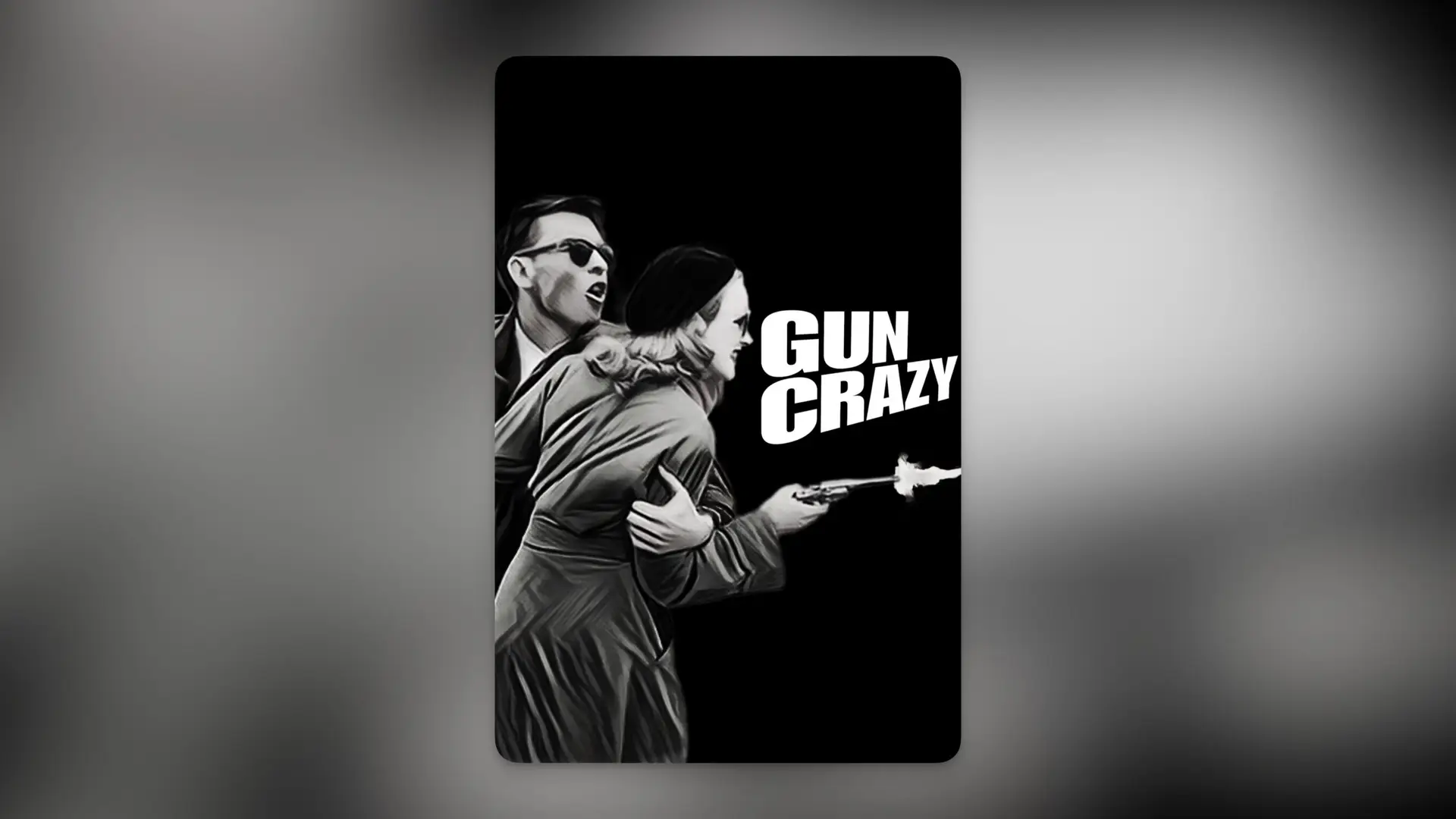
I expected Gun Crazy to be more dangerous than it is, which is maybe a strange thing to say about a movie built on of guns, sex, robbery, and a general sense of doom.
This movie had become parental contraband. Protect your children from Gun Crazy. Hide the silver. Lock the cabinets. Whatever I thought I was going to see, it was not quite this: a lean little noir romance about two people who meet at a carnival, recognize the same brokenness in each other, and immediately become everyone else’s problem.
The guns are the pathology, sure. They are also the courtship language. Bart and Annie do not flirt across a soda counter. They shoot candles off each other’s heads. Their meet cute is a pistol competition under the big top, and Joseph H. Lewis shoots it with more heat than most movies manage in a bedroom. It is ridiculous and completely legible.
That is the part of the movie that feels alive. I do not think either of them becomes whatever they become alone. Bart would probably have spent his life as the derpy hometown gun obsessive with a display case, a few good friends, and a long future of making people nervous at county fairs. Annie might have stayed on stage, weaponizing charm and marksmanship for applause instead of payroll money. Together, they become combustible. He has plenty of guns in his life before she arrives. She is the one missing from the collection.
Peggy Cummins is small and plays about a hundred and fifty feet tall. Annie Laurie Starr enters as a performer, and she never really stops performing. The carnival act becomes the crime spree. The costume changes, the audience changes, the stakes get worse, but Annie is still on stage, still turning danger into authority. Cummins does not make her safe or sympathetic in any easy way. She makes her thrilling enough that Bart’s stupidity becomes plausible. I do not know that I ever fully bought John Dall as the male half of this couple in the old movie-star sense. He does not have Cagney voltage. He does not have Fred MacMurray’s great trick from Double Indemnity, the square office man suddenly revealing a moral sinkhole under the haircut. Dall is softer, stranger, more recessive. Sometimes he reads less like a doomed outlaw than a guy who wandered out of a civics textbook and got in the wrong car. Bart is not built for crime. He is built for guns. He loves the object, the skill, the ritual, the case of pistols shown to his friends like a vacation album. He supposedly hates killing. Annie has no such problem. She gets scared, pulls the trigger, and leaves Bart to discover bodies in the newspaper.
This is where the movie reads less anti-gun than I expected. Its position, if I can be glib about it, seems to be: get your emotional life in order, because guns are awesome. That feels archaic and current. Bart is the fantasy of the responsible obsessive. He made one childhood mistake, learned the lesson, went to reform school, joined the military, taught marksmanship, and came home still fundamentally attached to guns as identity. The film does not treat that attachment as the whole problem. It treats Annie as the catalyst that turns it into catastrophe.
That is why I have a hard time buying the heaviest political readings of the film. Yes, Dalton Trumbo wrote under a front, and yes, his blacklist history is practically important. It is biographically fascinating and morally ugly in the same way all blacklist stories are morally ugly. But I did not watch Gun Crazy and feel a major indictment of the carceral state or gun culture taking shape underneath the romance. Maybe it’s there. Maybe I need more Trumbo in my bloodstream. To me, the movie plays first as a B-noir lovers-on-the-run picture that knows exactly how much myth it can get out of two beautiful idiots and a couple loaded pistols.
Everybody talks about the bank robbery shot. Three and a half minutes in the back seat of a car, actors improvising, a real street, a fake crime moving through real public space. It is true low-budget ingenuity. More greasy wood in cars, I say.
But the final fog sequence is the one that got me. Bart and Annie in the reeds, the old friends calling from outside the white, the sense that they have run past roads and laws and ended up in judgment county. It looks better than the famous shot because it feels like a grave opening. Bart sees Annie raise her gun toward the people who still remember the man he used to be, and he shoots her. Then the police shoot him. The whole ending happens almost before the movie can mourn it, and all the noir grief the story has been gathering finally has a drain open up beneath it.
Lewis and Russell Harlan lift the movie there. Not every scene carries the same charge. Some of the film drops back into flatter, more proscenium staging, and the story itself is simple enough to fit on the back of its own wanted poster. But the sequences that have it, have it: the carnival, the car, the meat-packing robbery, the fog. The frame keeps turning into a trap, especially once Bart and Annie are living out of cars and motels and bad choices.
I came away less scandalized than pleased. Gun Crazy did not corrupt me, unless we are counting a renewed interest in the Internet Movie Firearms Database, which tells me there are nine guns in this movie. Apparently that is the line. Eight guns is a hobby. Nine guns is “crazy.” So, I like it more as doomed romance than political artifact, more as filmmaking exercise than moral warning, and most of all as a meet cute for people who should absolutely never have met, cute or otherwise. It did not change the way I live my life day to day. It did, however, fill in a missing piece of the lovers-on-the-run map.