
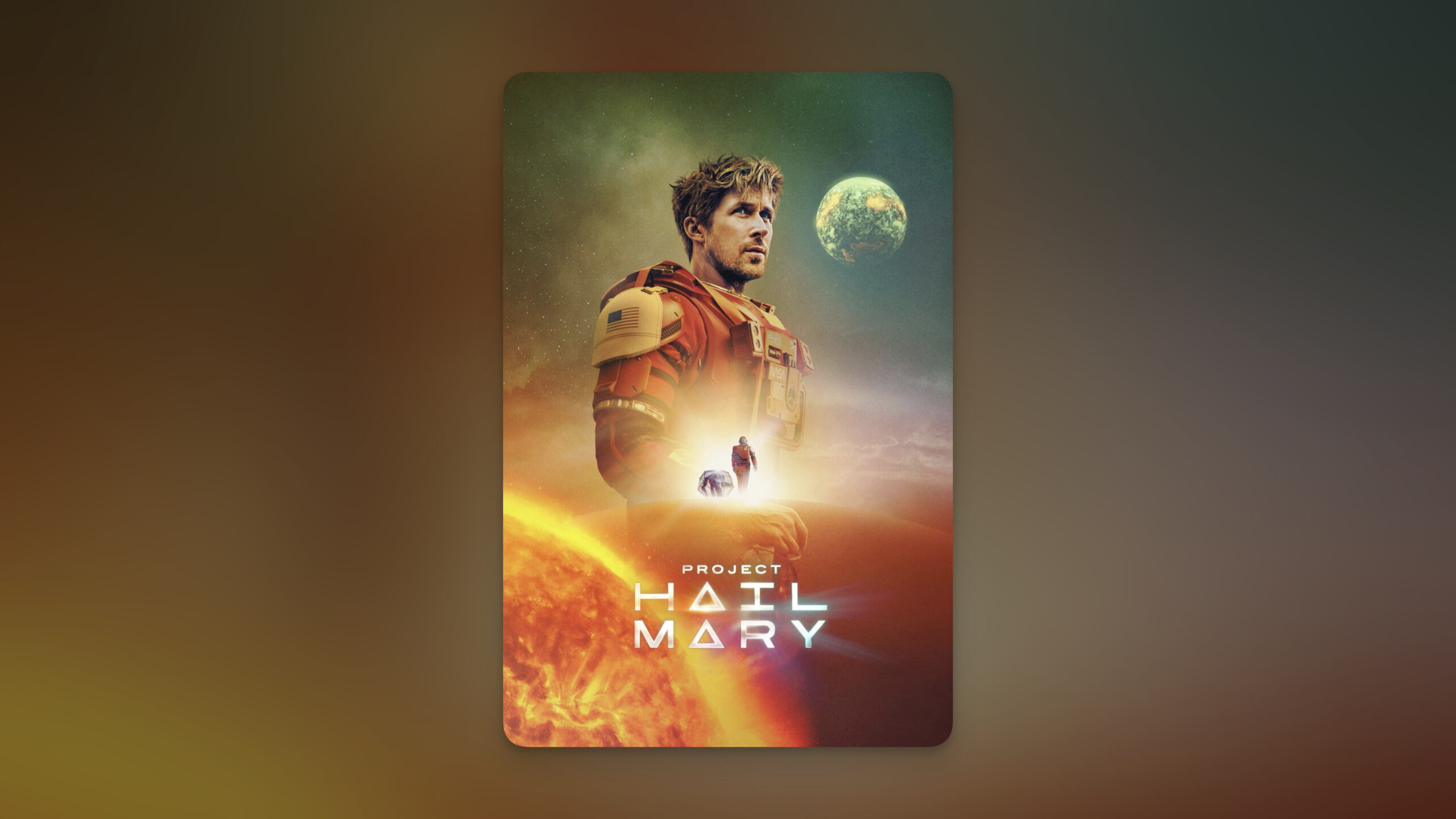
The production is gorgeous. I want to start there because it’s the thing I’m most confident about and the thing I suspect will hold up longest. Lord and Miller committed to building this film practically (no greenscreen, physical sets, a puppet designed by Neal Scanlan and performed by James Ortiz in every scene with Gosling), and the result is a movie that feels handmade in a way that studio science fiction almost never does anymore. Rocky is the achievement. A five-legged, eyeless alien built from physical materials and operated by a human being on set, and I believed in him completely. More than believed. I cared about him more than I cared about anything else in the film, which is both a tribute to the craft and, if I’m being honest, a diagnosis of the film’s central problem.
I was bored through most of this movie. The same way I was bored through most of the book. Andy Weir writes science-problem narratives with clarity and rigor, and the structure is always the same: problem, science, solution, new problem, more science, new solution. And at a certain point the rhythm becomes predictable enough that the tension drains out. You know Grace will figure it out. The question is just which discipline he’ll use and how many whiteboard sequences you’ll sit through before he gets there. At 156 minutes, you sit through a lot of them.
Ryan Gosling keeps the thing watchable, which is not nothing when you’re alone on screen for roughly ninety minutes. But his charm operates in a narrow register (warm, slightly bemused, quietly decent), and the film asks him to sustain that register for over two hours without much variation. When Rocky arrives, the film wakes up. When it’s just Gosling doing science and narrating his own process, it drifts. The friendship is the engine. The science is the fuel. The problem is the ratio.
The structure is nonlinear. Grace wakes with amnesia, and the Earth-based flashbacks fill in how he got to Tau Ceti. The device works better than it should. The flashback material is where Sandra Hüller lives, playing Eva Stratt as the person making the hardest decisions in human history with tears running down her face and no hesitation in her voice. The reveal that Grace didn’t volunteer, that he tried to run and was drugged and launched against his will, retroactively complicates everything you’ve watched him do. That’s a structural choice that earns its placement, and Drew Goddard, who also adapted The Martian, knows exactly where to put it.
The ending is where the film finds something real. Grace sends the solution back to Earth and stays for Rocky. Selflessness over survival, friendship over homecoming. It lands. The final image, Grace teaching young Eridians in a biodome, reframes his whole arc: the man who thought teaching was a consolation prize discovers it’s the most important work he’s ever done. That moved me, and I don’t think the feeling is cheap.
Four stars, and I say that knowing the number will probably come down. The production is beautiful, Rocky is a triumph of practical filmmaking, and the ending earns its warmth. But the middle sags under the weight of its own formula, and the Weir template, which worked at two hours in The Martian, strains at two and a half. I walked out moved and slightly relieved it was over, and I’m still deciding which feeling is the more honest one.