
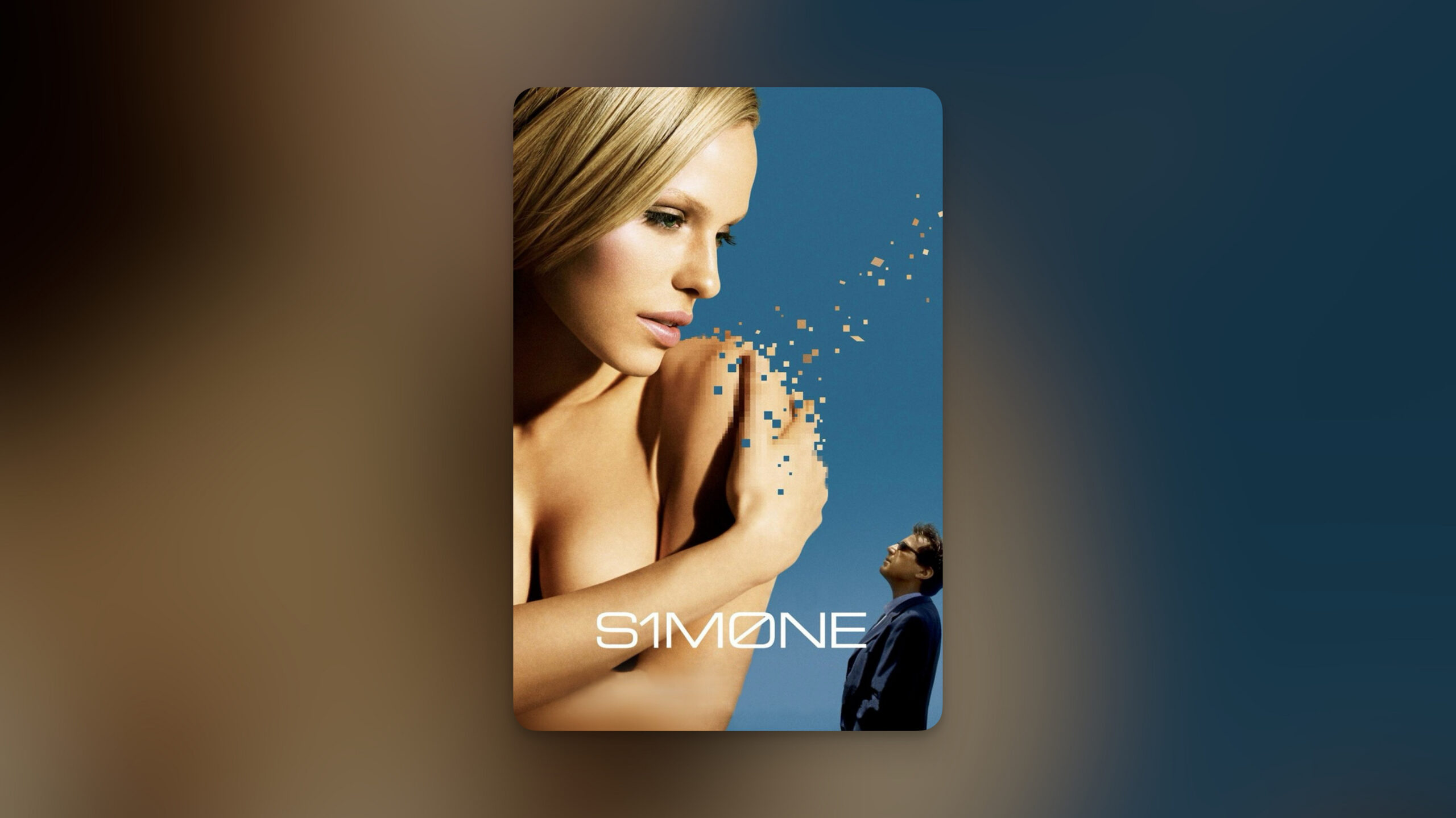
Final Fantasy: The Spirits Within landed in July 2001 with a $137 million budget, photorealistic CGI performers, and results so catastrophic they nearly bankrupted Square. The anxiety about synthetic actors replacing human ones was not theoretical when Andrew Niccol wrote S1m0ne. It was recent, expensive, and documented in the trades.
So the choice to make a caper comedy about it is a… well… a choice.
Viktor Taransky, Pacino’s sulking, contractually imperiled director, receives a gift: software capable of generating a photorealistic virtual actress, flawless in every take, no ego, total obedience to direction. He uses it to finish his film. The film is a hit. Simone becomes the world’s most famous actress, and nobody knows she doesn’t exist. This is the satirical setup, and for a first act Niccol runs it fine. The Hollywood target practice is acute: Winona Ryder’s Nicola Anders walks off a production over the placement of a trailer, and the scene nails how completely the industry has organized itself around the management of performer ego. Pacino is well-cast here in the way that specific actors are well-cast for specific grievances, especially given the meta-experience of his reputation as an incredibly intense actor. His Taransky is a man who wanted to make art and ended up in negotiations, and that bitterness sits naturally on him.
But once Simone exists and the world swallows the fiction, Niccol seems more interested in the logistics of maintaining the lie than in what the lie actually means.
What the lie means is where the film was always headed and never arrived. The screenplay keeps gesturing at audience complicity. Everyone projects what they want onto Simone precisely because there is nothing there to project onto. The observation stays at the level of observation. Nobody is implicated. Nobody is asked what it costs them to need this. The film watches people believe in a fabrication and finds it amusing, which is a less uncomfortable position than finding it true.
The failure of nerve eventually becomes definitive. Taransky is arrested, exonerated, reconciled with his ex-wife, and restored to professional standing. Simone continues. The mechanism that made her possible keeps running. The industry that embraced her without question goes on embracing her. The only consequence of the entire deception is that the director gets his life back, which reads less like dramatic resolution and more like wish fulfillment for the side that caused the problem.
The more corrosive accountability gap is the one the film doesn’t notice. Hank, the engineer who built Simone, dies before the story properly begins. He bequeaths the software to Taransky and exits, spared the inconvenience of being alive when consequences arrive. The film treats him as a benefactor, a visionary whose gift is simply mishandled by the man who received it. Taransky is a user, a middleman, and it is on him that the film’s limited moral weight settles. Today, the ire directed at artificial intelligence points almost entirely at the people who built it: the labs, the engineers, the executives who decided the technology should exist and be deployed. S1m0ne could not imagine that framing. Its creator is a ghost, conveniently beyond reckoning, lionized by his own absence.
The rescue arrives via Taransky’s daughter Lainey, not yet sixteen, played by Evan Rachel Wood. She discovers her father deleted Simone. She restores the AI herself, stunning the adults with technical capability the film introduces at the precise moment the plot requires it and never establishes before or after. I am a fan of the teenage savior when it is done well: when the competence has been built, when the discovery carries emotional weight, when the character’s arrival costs something. Here it is pure mechanism. The screenplay needed someone to press the button and selected the person least likely to know where the button was. That is a different operation from a well-executed surprise, and the difference is not subtle.
Viewed against Niccol’s fuller filmography, S1m0ne is the outlier. Lord of War commits to its ugliness. In Time holds its metaphor even when the seams show. S1m0ne is the film where Niccol built a system capable of real discomfort and chose, at every turn, the exit that kept the movie comfortable. The uncomfortable version of this film (the one that treats the audience’s hunger for Simone as something to reckon with rather than something to observe from a safe distance) was not made in 2002. Something in the neighborhood of it arrived in 2013, from Spike Jonze, about a different kind of artificial companion and with a different willingness to sit in the implications.
S1m0ne found the right subject and did not trust itself with it.