
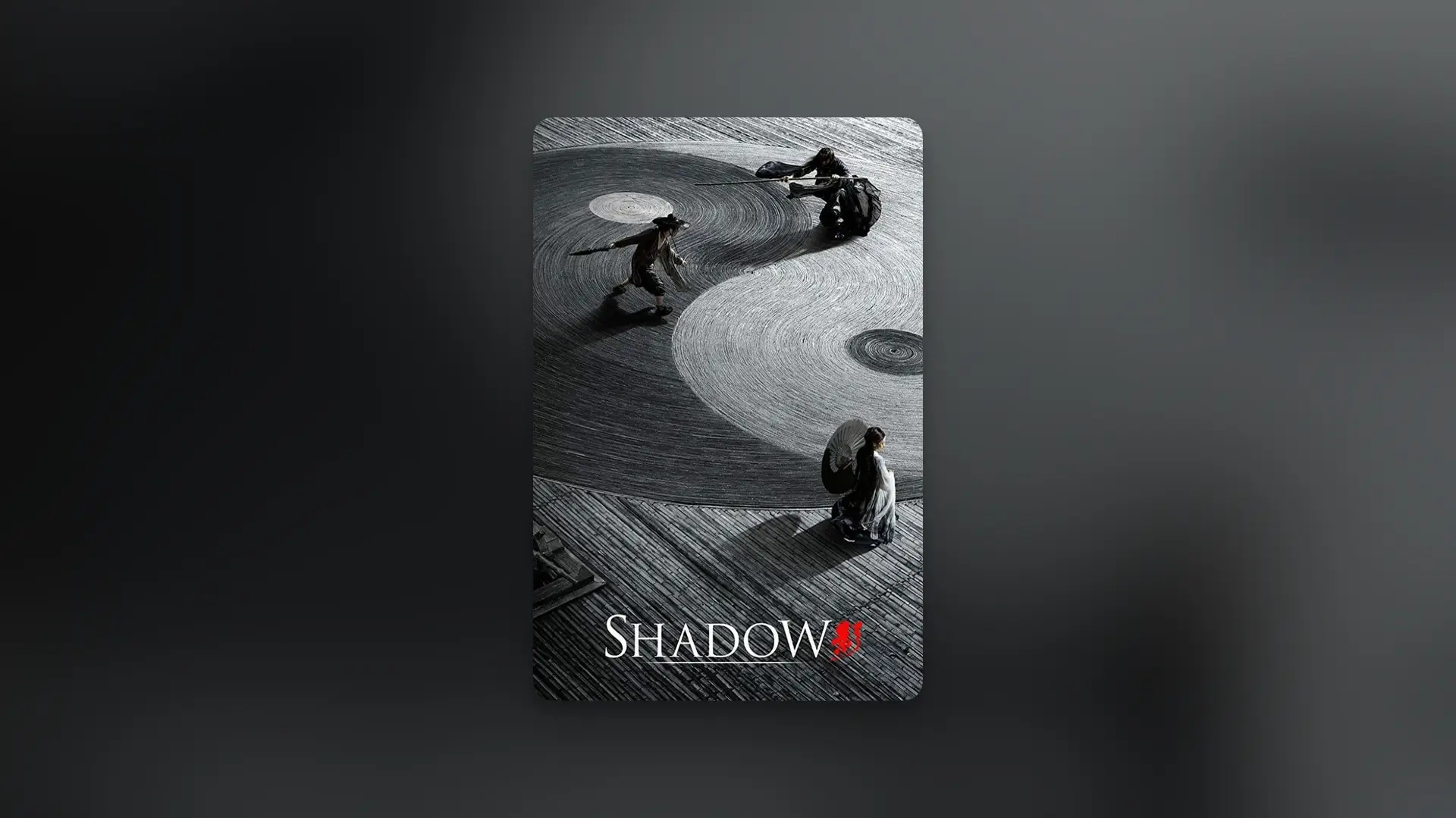
I came to Shadow with one read already in my head. This was the apology film. The Great Wall had been a mess (though probably better than I remember) and Shadow was the film where Zhang went back to making something he could stand behind. The watch mostly confirmed that read. Then it surprised me with where it landed. I think this might be my favorite Zhang wuxia. That includes Hero, which I haven’t rewatched in almost ten years, so track that as a caveat. With the caveat in place, I’m putting Shadow at the top of the wuxia stack and I didn’t expect to.
For years I thought Zhang’s color period was about color. Turns out it was about dynamic range. He’s spent decades chasing extremes of palette, of character, of tone, of place. The lush red of Raise the Red Lantern comes from the same place as the muted gray of Shadow. Same impulse, opposite direction. Here he strips that tool away and goes looking for the same effect in the gradients of ink-wash gray. The result is the most disciplined visual work of any of his late films. I keep coming back to the decision to build it physically instead of grading it in post. The blacks and whites and wet grays are baked in. They’re on the silks, on the walls, on the actors’ skin, in the rain itself.
I found this more satisfying than House of Flying Daggers as a story. Not because the plot is stronger. They’re at roughly the same level. The balance between melodrama and intrigue works better for me here. The doomed-romance stuff in Daggers didn’t work. The court politics in this one do. I’ve seen criticism of the court scenes as slow, but those scenes are where the movie cements any of its climactic violence. I’m interested in the king’s manipulations, Qingping’s betrothal, Tian Zhan’s resignation. The duel only matters because of the forces arranging it from behind the curtain.
The umbrellas are just awesome. They don’t exist. There’s no historical Chinese martial-arts weapon that does what these things do. Zhang and his collaborators invented them and committed completely to the bit. Each one is built from about two dozen sharp curved blades that spin together as a single weapon and release as individual flying daggers (amazing) and serve as shield and cutting tool and at one point as a sled. The convict-strike-force sequence where they’re sliding down hills sitting inside cocooned pairs of umbrellas shooting people on the way down is the kind of flamboyant exuberant invention I want from every wuxia film. The umbrella is a love letter. It’s also where I have my one real axe to grind on the production. The umbrellas get bent. They take damage during the duel and they look pretty stupid after they’ve been used at all. I wanted Wakandan vibranium umbrellas that stayed pristine through every action sequence. Give me an umbrella that wears like a sword. These things flop around after the first hit and start to look just plain ridiculous.
Deng Chao is good. The forty pounds got more press than the performance which is unwarranted. The weight change impressed people. It also became the easiest thing to talk about. Deng is playing two distinct psychologies and he manages the split well. The work deserved more attention than the diet.
This still doesn’t belong in the top tier of dual performances. Armie Hammer playing the Winklevoss twins in The Social Network lands harder. Tatiana Maslany on Orphan Black is doing something in a different universe. Those performances create separate people. Deng’s two characters are similar enough that you read them as the same body in different costumes.
I wanted more grit out of Shadow than I got. By the end I wanted more Park Chan-wook. I wanted Oldboy. The retribution angle is in the script but the movie is too clean to deliver on it. That’s a quibble. I’m being petty. But if Zhang had let himself get a little uglier in the last twenty minutes … boy-howdee look out.
The film ends with a massacre that wipes out nearly every named character. I don’t have the hand-wringing about that carnage that some critics do. It’s a wuxia film and wuxia ends with bodies. The film has been balancing toward this for two hours.
The final image works for me. Xiaoai at the doorway. After all the doubling and mirroring, everything collapses to one survivor and she has to decide what to do next. She doesn’t get to control how the story will be told about her. She has to stand there and live with it.
I’d place this above House of Flying Daggers comfortably. Above Hero, maybe, with the asterisk that I owe Hero a rewatch before I commit to that. The cultural films are a different conversation. Raise the Red Lantern and Ju Dou and To Live are making Zhang’s strongest case as a serious filmmaker. For the wuxia, this is the one.
Where Shadow ranks doesn’t really matter. Zhang came back from The Great Wall and made a truly unique film experience. The symbolism works even when it’s obvious, the characters keep me at arm’s length, and the ending still has questions I haven’t settled.
And still, the apology-film read survives. Umbrellas for days.