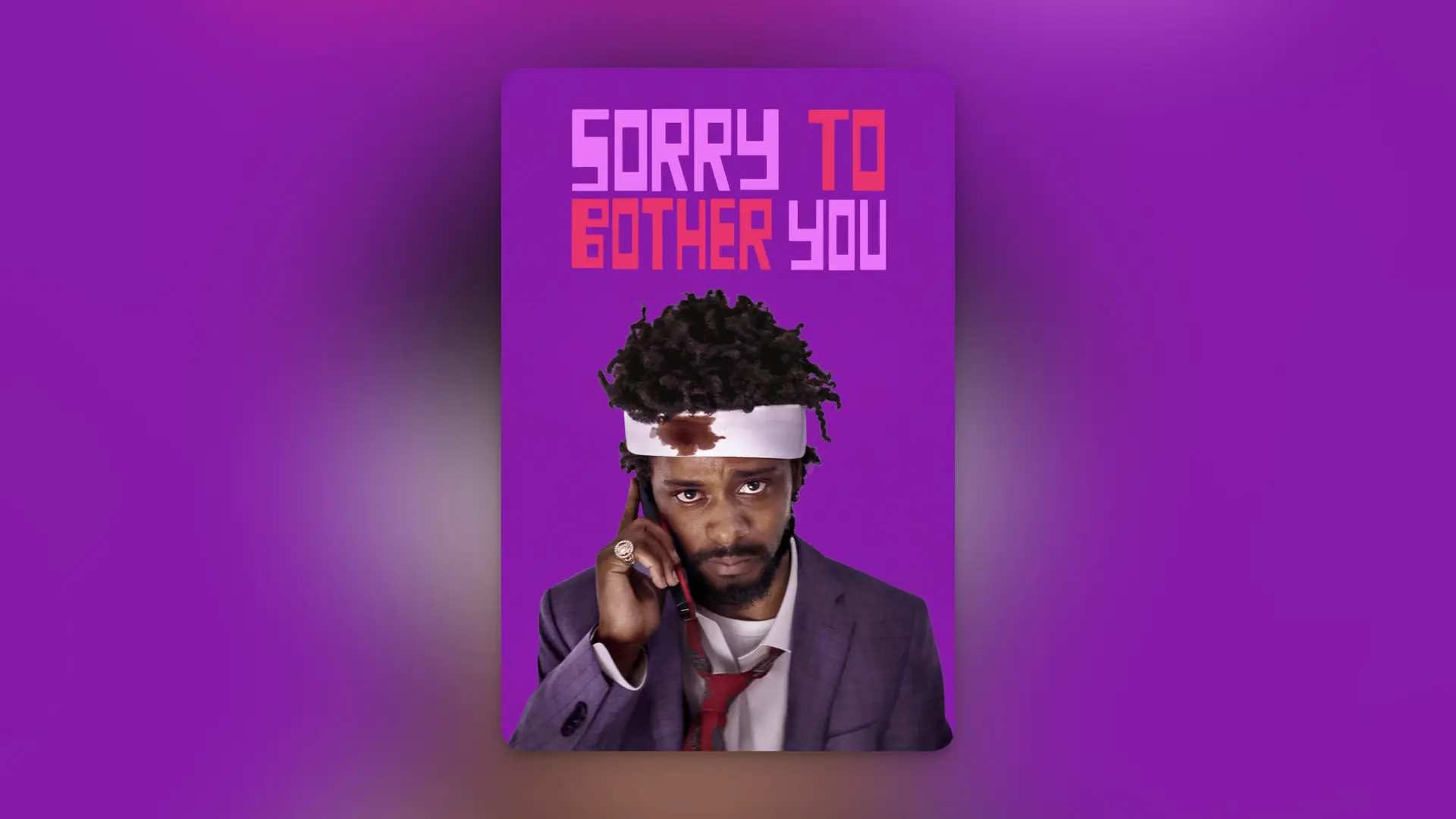
First time I saw this was in a theater with Andy and we were falling out of our chairs. Rewatching it I’ve come down, and I did check whether that’s just me being grumpy.
Some of what I still love about it is inseparable from how it got made. Boots Riley had spent about thirty years fronting The Coup and organizing in Oakland and had never directed a narrative anything. He finished the script in 2012, couldn’t get one person to make it, and turned it into a Coup album instead. David Cross only read it because his assistant was housesitting and got bored. Dave Eggers eventually called it the best unproduced screenplay he’d ever read and published it as a paperback inside McSweeney’s, which got Riley into the Sundance Labs, which finally got it made — sixty-one locations in twenty-eight days for $3.2 million. You can feel every bit of that. There’s Brazil in here, and Twelve Monkeys, and about nine other things running at once.
The first half I still love without reservation. The way his desk drops into people’s dinners and their sex lives every time the phone rings is one of the best translations of an experience I’ve ever seen put to screen, and I love that one irrationally. The white voice overdubs are exceptional. David Cross over LaKeith Stanfield, Patton Oswalt over Omari Hardwick, and the reason they land is that Riley dubbed them rather than having his actors do impressions, so you hear the seam. The one that gets me is Lily James over Tessa Thompson, because Detroit sort of sounds like that already and I didn’t clock it as a dub at all the first time through. Danny Glover’s, for the record, is not Steve Buscemi no matter what you’ve heard. It’s the movie’s sound engineer.
WorryFree is the best kind of prison, the kind nobody wants to leave, and those ads full of happy people in their bunks say more than most of the movie’s bigger swings. What the thing is really chewing on is how badly corporations need you to code-switch for your own advancement, and how neatly your advancement then serves theirs. The two middle managers doing a team-building bit and getting asked whether it comes with more money is my favorite sense memory of my own corporate awkward history.
I love the Equisapiens and it is the biggest swing in here, and Forest Whitaker, who produced the film, voices the first one. But the twenty minutes before them are so conceptually noisy that I’m worn out by the time we get there. And now the horse people are what everybody remembers, instead of Tessa Thompson in a hand bikini taking sheep’s blood to the chest, or Detroit’s earrings quoting Dylan and Prince and The Coup all at once. Pull the horses out and the whole thing gets more even, and a lot more direct about what Cash is actually doing for a living.
The world treated it about how you’d guess. It made $18.3 million against $3.2, won the Independent Spirit Award for Best First Feature, got Riley a DGA nomination for first-time director, and pulled exactly zero Oscar nominations. It also sat three months without an international distributor because buyers told Riley’s people that Black films don’t travel. Final overseas gross was under $800,000.
Too many great ideas landing a little haphazardly. Worth seeing once, and best with people who haven’t seen it.