
I like Wes Anderson. I have always liked Wes Anderson. I can’t get my family to join me in this appreciation, which is their problem.
The Grand Budapest Hotel is one of the movies I point to when somebody asks me why. It is Wes Anderson working at full Wes Anderson: every color, costume, miniature, camera move, and line reading pressed into the same service. Nothing wanders in from some other movie. I find that exhilarating.
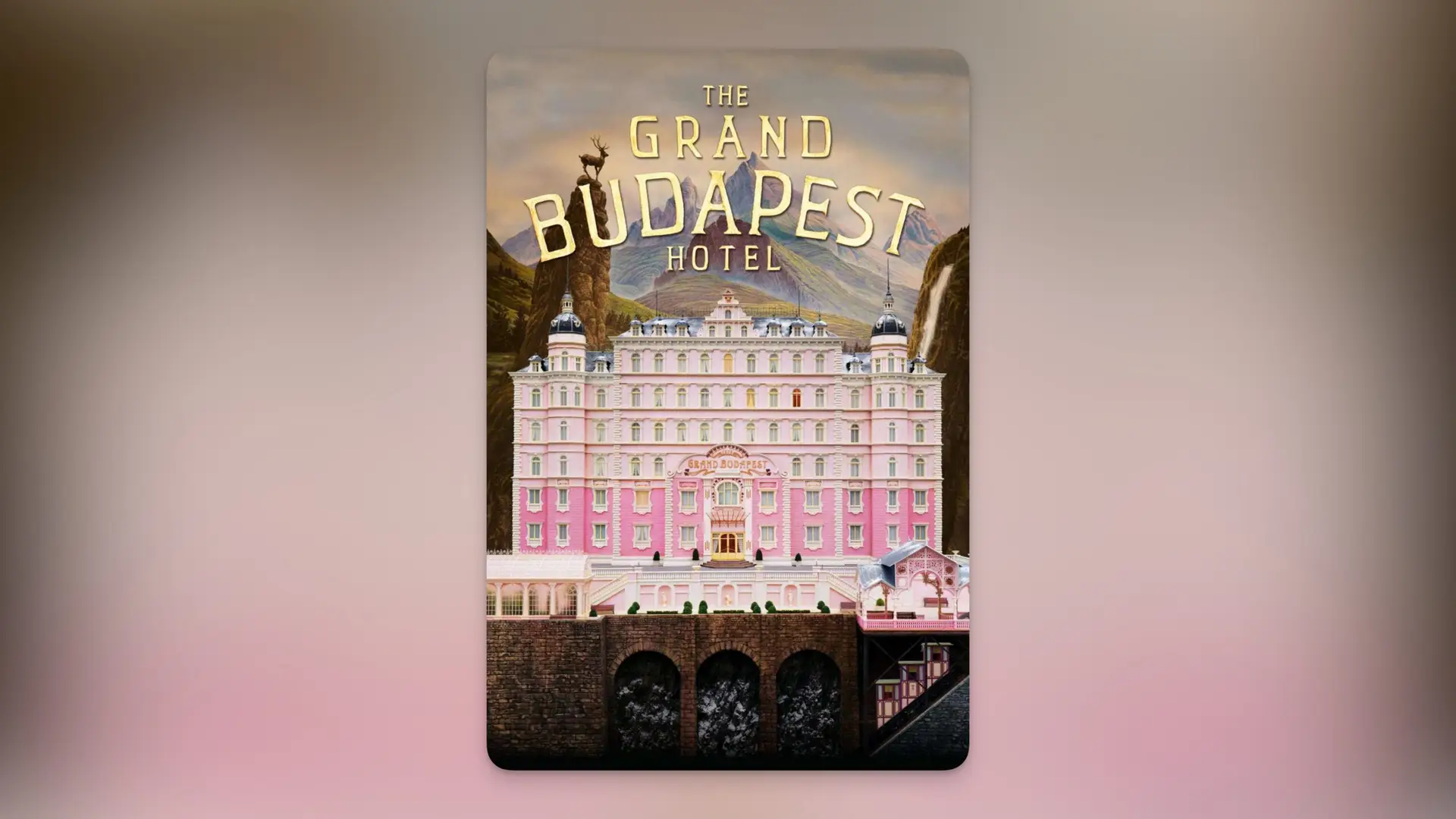
For Movies We Like, we talked about the film with costume designer Ann Maskrey. Listening to her talk about Milena Canonero’s Oscar-winning work put professional language around something I already loved. Ann kept coming back to how completely the costumes and production design belong to each other. The purple lobby uniforms, the Mendl’s boxes, the cakes, the van, the hotel… it all just melds.
Her best example is the Mendl’s box arriving as almost the only splash of color in the prison. Even the pastry delivery has to carry the whole visual scheme with it.
The palette lives in a very narrow range of reds, pinks, and purples, and we stay there long enough that it burns itself onto my sense memory of the movie. I said that on the show and I still can’t find a better way to put it. I can see the color before I remember half the scenes. Ann mentioned that her partner didn’t like the color and all three of us responded as if they had insulted us personally. The thing is clipped and symmetrical and pink. The miniatures look like miniatures. The dialogue moves so fast Ralph Fiennes occasionally appears to be firing it from a steampunk weapon. The Society of the Crossed Keys is a pastel A-Team. Even Boy with Apple is fussy, smug, and deeply ugly.
Anderson is juggling four periods in this thing. I forget that when we discuss it, but I never lose my place while watching. The aspect ratios change. Tom Wilkinson becomes Jude Law. F. Murray Abraham becomes Tony Revolori. The voices pass the story backward without a bump. That is an absurd amount of precision devoted to making the structure feel as easy as it ends up being.
Ann’s favorite part is Fiennes’ delivery, particularly the moment when one of Gustave’s grand speeches about civilization runs out of road and ends with “fuck it.” Fiennes can make Romantic poetry and the obscenity sound equally proper. Gustave is vain, fraudulent, generous, vulgar, racist, apologetic, and very brave. The movie doesn’t clean any of that up for him. His manners are something he keeps doing while the world around him stops rewarding manners. He has protocol and a bottle of cologne. It sounds ridiculous written down. Fiennes makes it feel necessary.
On the show I called fascism a tonal intrusion into the bright story. I think that’s the film’s at its most mean. The first train encounter can still be handled as a problem of rudeness and politeness. On the second train, nobody cares how polite Gustave is. The joke is over. No more comic escapes available. The movie moves right along at a brisk clip and the slams into grief.
The Stefan Zweig connection helped me understand that sadness. Anderson built the film as a tribute to an Austrian writer who had once been read everywhere and is now mostly a name in the credits of a Wes Anderson movie. Zweig wrote about a cosmopolitan, humane Europe while fascism was tearing it apart. He lived in exile and killed himself in 1942, convinced that world was gone. That makes pink sad.
Tony Revolori lets Fiennes have all the speed while Zero watches and learns. F. Murray Abraham has to make the older Zero feel like the same kid after all those losses, and he does most of it by sitting still. The film barely raises its voice when it tells us what happened to Agatha.
Ann said there isn’t a thing she dislikes about the film. I’m close. This is Anderson doing everything I come to Anderson for, then using all that color and control to land a story about the people who are gone and the people left remembering them. I love the guy. I love this movie.