
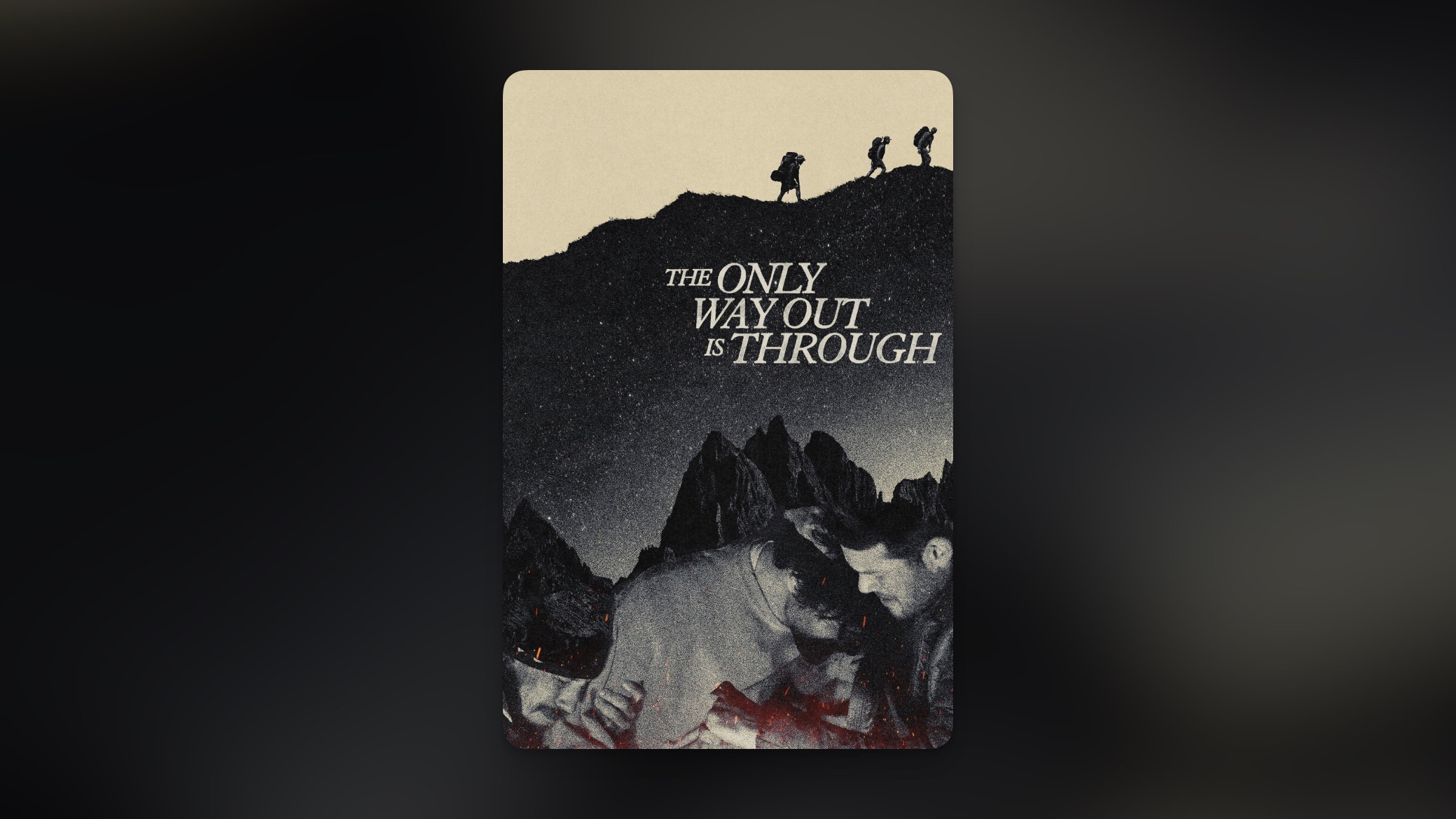
I knew nothing about The Only Way Out Is Through going in. Three men drive into the Colorado mountains with backpacks, and I settle in for mayhem and at least one murder. Instead, they keep having problems with each other that I recognize, and I’m starting to worry about what I’ve agreed to watch.
Oh God.
It’s male vulnerability.
Quick … dig a hole.
Evan (Alex MacNicoll) wants his friend Nolan to open up. He’s seen men do it around a campfire, so he’s organized a camping trip. He’s put thought into this. He loves the guy. By the time he’s explaining his reasoning to Mark (Beau Knapp), his determination to help has made him a complete dick. Mark asks whether Evan ever opened up at any of those campfires himself. No, he never did. Between them, those two had just described every relationship I’ve had with another man in my life.
I’d been following his reasoning about how to get Nolan to talk, and it hadn’t occurred to me to ask what Evan was prepared to say about himself. Mark barely has to ask the question before Evan admits it. There’s no elaborate deception to expose. He’s been expecting his friend to do something he has no practice doing himself, and somehow that hadn’t troubled either of us.
Director Kieran Thompson spent years working through this with screenwriter Kyle Dickinson after his own best friend’s car accident. He wanted to take his friend into the woods, too. They eventually talked at a pizza place, which I appreciate knowing, given that making the film involved carrying camera gear up a 14,000-foot mountain. I initially wondered whether he’d needed to go quite that hard. The location makes sense … by the end, these guys are stuck with each other. They can’t leave separately and let an unfinished conversation become another thing they don’t discuss. Getting them to that point takes most of the film, and I never felt hurried through it.
The night up there looks miserable. It’s cold and windy, and the actors are yelling over each other. Thompson says none of the dialogue was re-recorded, which is absolutely astonishing. The sound around it took considerable work: every footstep was rebuilt, and Ryan Collins shaped the birds and insects into a soundtrack that can become almost overwhelming. I wouldn’t have guessed how much of what I was hearing had been constructed. Work of art.
I wanted somebody to talk on the walk down. There’s no score anywhere in the film, and now there isn’t even a conversation, just these men walking apart in shots wide enough to show the whole peak. Editor Misty Wilson lets those shots run. I know I’m being given time to process, and by this point I’m through processing, thank you. Please, would somebody say something? By the time one of them says “Nolan,” I can hardly stand it. Thompson calls this the day of silence. He says men can spend hours together talking about nothing, and he wanted to make that impossible here. I felt how long they went without speaking. I also don’t want a minute of it taken out.
I hate-love this movie. My list of people who need to see it is long and distinguished.