
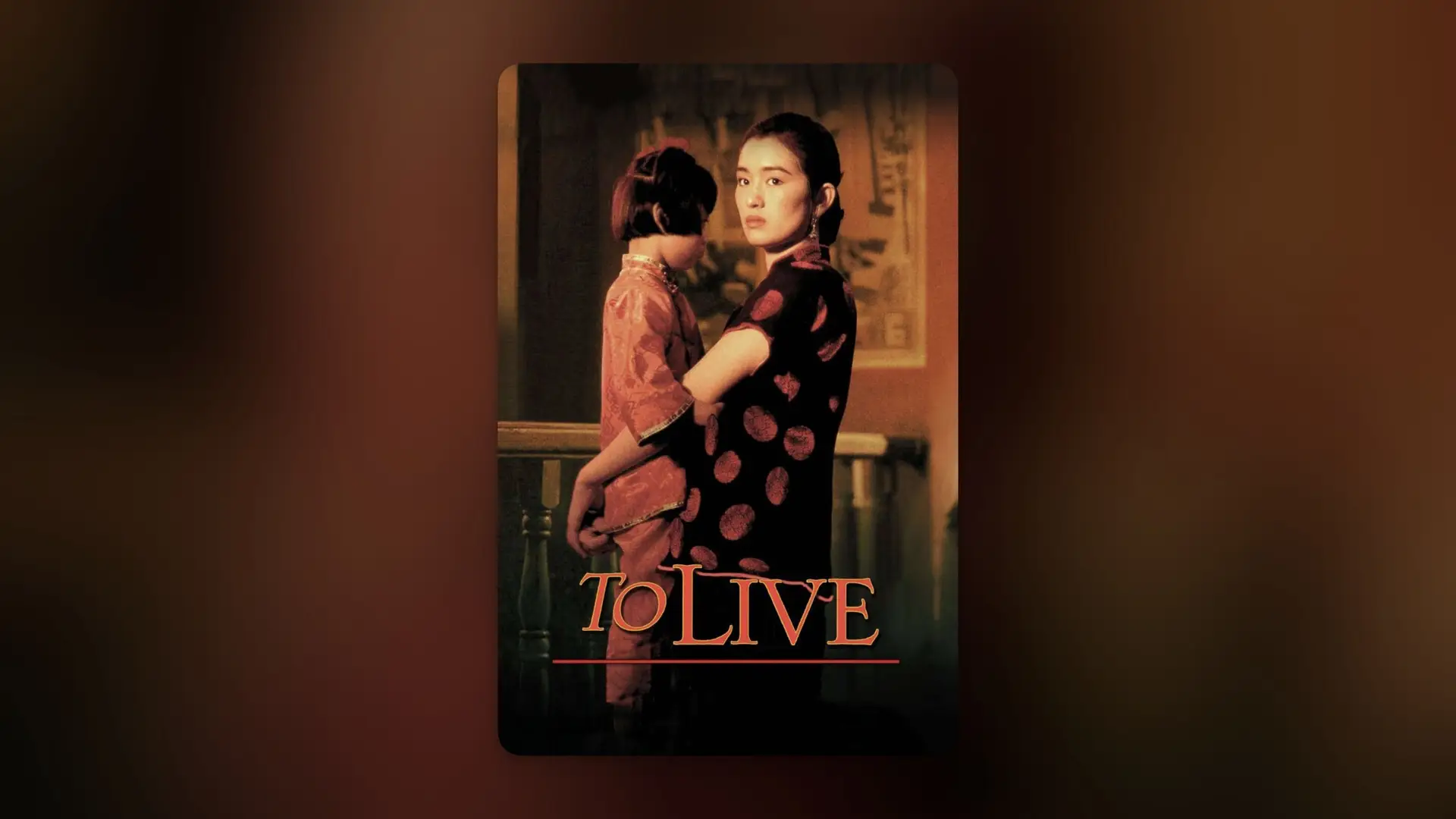
<div id="content"><p>The thing that surprised me about <em>To Live</em> is what isn't in it. The Zhang Yimou I know, the Zhang of <em>Ju Dou</em> and <em>Raise the Red Lantern</em>, is a stylist. Color is a primary language. Composition is buried in his politics. The red lanterns in front of a closed gate carry more argument than dialogue. I came to <em>To Live</em> expecting that Zhang. He didn't show.</p>
What I got is a film made at eye level, in muted palette, with a camera that mostly … just … watches. Lü Yue shot this and apparently he was told to disappear. Zhao Jiping’s score is sparse and gets out of the way, too. The director who built his international reputation on stylized rural mythology has, for two hours and twelve minutes, put down his tools and trusted actors and story to do the work he had previously been doing with set design and chromatic logic. You want to call that restraint. Might be better termed surrender. Zhang surrendered the style to the story and I’m still trying to figure out how I feel about that.
My first instinct is to prefer the other Zhang films of this period. Raise the Red Lantern is the film I keep returning to when I think about what Zhang does when he’s at his best. To Live does not operate the way that film operates. The pleasure I take in Zhang’s earlier work is partly the pleasure of his intelligence, his framing of a courtyard, his timing of a fade.
I don’t know if I’m preferring Zhang’s work or just preferring the version of his work I’m used to. To Live is asking me to read a character piece. I have been reading Zhang as a stylist. The two readings demand different things from an audience and I am not sure whether any dissatisfaction with the film is a real critical position or a habit of taste I haven’t examined. I want to leave room for the possibility that this is the better film and that my response to it will improve the next time I watch it. But the next two films in our series take us right back to style. Stay tuned, I guess.
I’m sure about the puppets, though. This thing is puppets all the way down.
Fugui receives a shadow puppet troupe from Long’er, the man who has ruined his family. He learns the trade. He performs through the Civil War. The Kuomintang conscripts him and then the Communists capture him, and in both armies he performs the puppet operas for the troops. The puppets travel through the political reversals because they are pre-political, or seem to be. They are folk art. They belong to the old China that neither side of the war has time to dismantle yet.
Then the Great Leap Forward. Fugui performs the puppets in the public square between the steel-furnace shifts to keep village morale up. The puppets aren’t ideologically suspect yet. They’re tools.
Then the Cultural Revolution. The town chief tells Fugui the puppets have been deemed counter-revolutionary. Fugui burns them. He keeps the chest.
And then there are chicks in the chest. The vessel outlasts the contents. The art is gone but the form is preserved, and the box that used to hold tradition now holds some semblance of a future.
The shadow puppets are Zhang’s invention. They aren’t in Yu Hua’s novel. But they become the film’s calendar. They mark every era of mid-century Chinese cultural life by how the regime treats them. Revered, then treasured, then feared, then hated. By the end, absent except as container. The puppets are how Zhang tells us, without ever saying it directly, what each of these regimes did to the cultural life of the country it was running.
That metaphor is almost too tidy. Zhang built a structuring device that does a lot of work and the work is sometimes more visible than the film would like it to be. But the alternative critique, that Zhang should have given me more of his stylized signature instead of trusting his actors and his boxed calendar of puppets, is I’m increasingly convinced the critique I would make if I hadn’t been paying close enough attention.