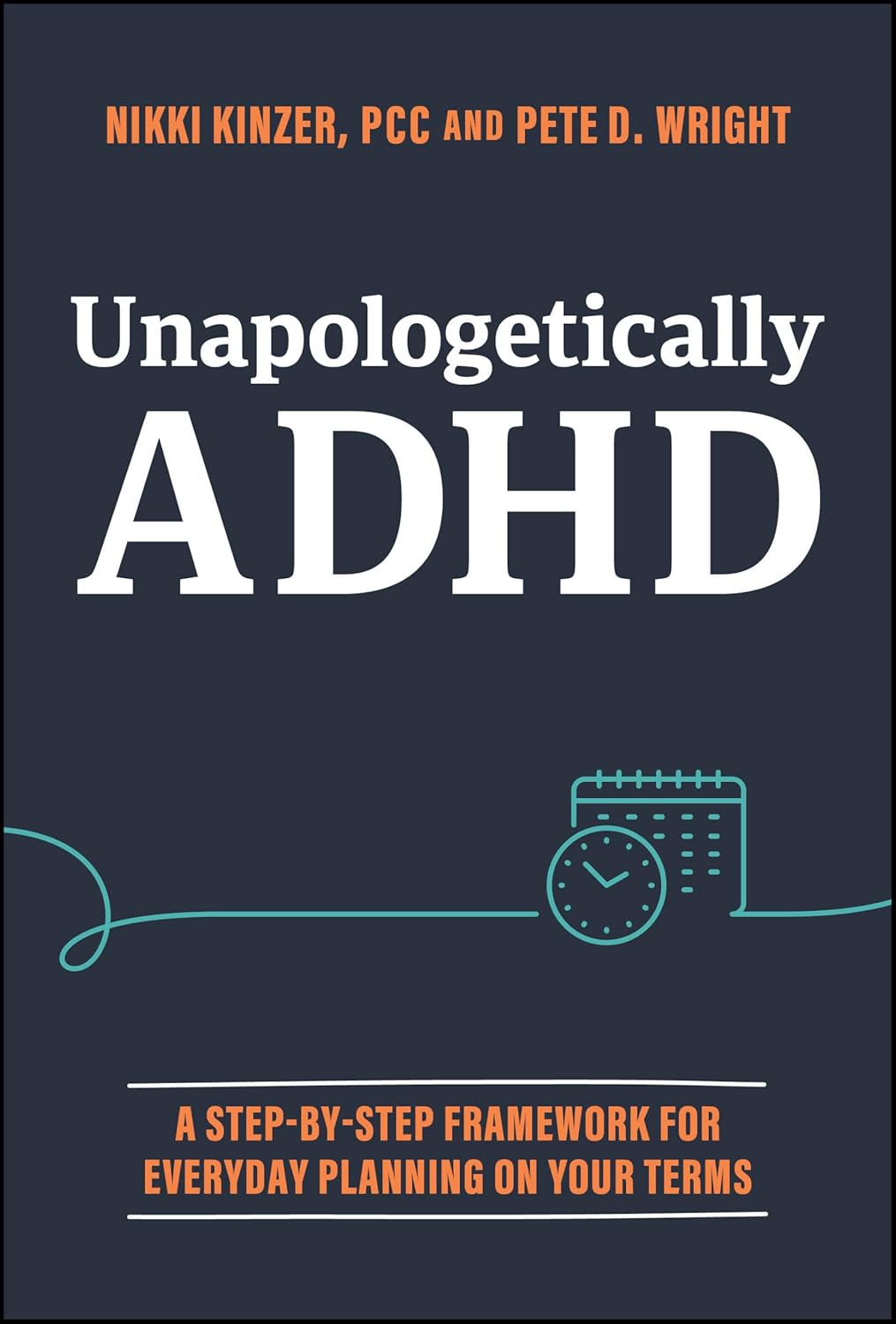
Written for the brains that have been told they're doing it wrong. Nikki brings the coaching architecture. I bring the lived experience and the occasional digression into why "best practices" are often just someone else's practices with a lot of big promises.
Nikki and I didn't set out to write a book. That's not how this started.
An acquisitions editor came to us — she'd been a listener of Taking Control: The ADHD Podcast for a while and wanted an ADHD planning book in her slate. She believed in what we'd been building together for years on the show, and when she asked if we'd be interested, we didn't hesitate. We loved the idea and dove in headfirst. Which, if you know anything about ADHD, is pretty on brand.
What I didn't expect was how much fun it would be.I'd made a clear plan — specific essay concepts, a structure I could actually see — and every night I'd walk over to my neighborhood Barnes & Noble café, open the laptop, and just start checking things off. There's something almost meditative about that. The hum of a coffee shop. A list with boxes to tick. It turns out that's exactly the kind of environment my brain needs to actually produce. Who knew a book about ADHD planning would teach me something about how I plan?
Writing with Nikki made all the difference. She doesn't have ADHD, which means she's a phenomenal accountability partner — steady, organized, and genuinely good at holding the shape of a project over time. That's the dynamic we've always had on the podcast, and it translated to the page better than I could have hoped. Nikki coaches. I live it out loud. You'll know when you're hearing from her and when you're hearing from me. That was intentional. We wrote in our own distinct voices because that's the only honest way we know how to do this.
The podcast made the book possible in ways that are hard to fully articulate. Fifteen-plus years of conversations — with listeners, with guests, with each other — shaped every page even if no single story made it in directly. When you spend that long inside a community of people who are genuinely trying to figure out how to live better with ADHD, it gets into you. You start to understand the texture of the struggle from the inside out. That's what I brought to the writing.
And what I brought from my own life — well. I was diagnosed 25 years ago, but I'd been living with ADHD my entire life before that without knowing it. I wrote this book for me at about 25, trying to hold down a job, trying to build relationships, trying to understand why everyone around me seemed to have a user manual I'd never been given. The shame of that period is something I still carry. The imposter syndrome hasn't gone anywhere either. I wrote a book about ADHD and I still fight those battles every single day. That's not a caveat — that's the point. This stuff isn't a problem you solve. It's a life you learn to live.
Here's the thing I want you to know before you open it: this isn't really a book about how to plan. It's a book about figuring out how you plan. There are as many ADHD brains as there are faces, and no single system — not ours, not anyone else's — is going to fix you wholesale. What Nikki and I built is a framework for going deep inside yourself, figuring out where you actually stand, and building something that works for your brain from there. The maladaptive hyperfocus. The lost time. The all-or-nothing mode that turns a missed deadline into an existential crisis. We see all of it. We wrote all of it down.
Because if there's one thing I want you to walk away with, it's this: there is someone at the other end of these pages who genuinely gets the struggle. It's not your fault that you live with ADHD.
But it is yours to live with. So let's do it the best we can.