
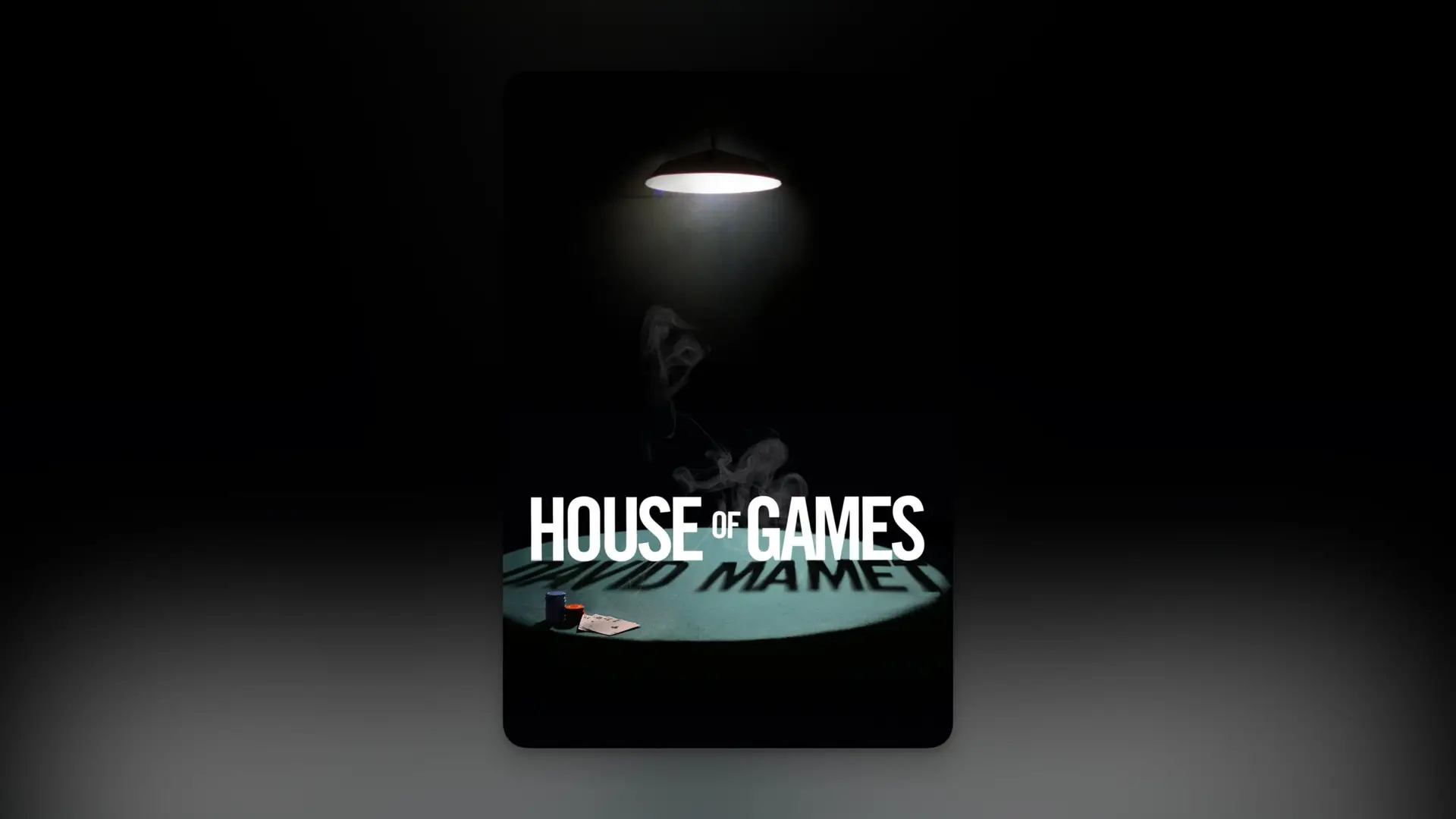
House of Games is not badly acted. It is acting from a universe where showing a feeling is how the money leaves the room.
Lindsay Crouse barely lets Margaret Ford blink. Joe Mantegna’s Mike explains the rules with the table already rigged. Everyone in this movie talks in units: one phrase placed on the table, another beside it, a third slid into position while you are looking at the first two. Naturalism never enters the bar. Mamet has built a workplace comedy for predators, and the job is composure.
The usual complaint about the performances feels backward to me. The flatness is in the film is the dress code. Mike cannot sell the con if he seems hungry for it. Margaret cannot be taken by him unless she recognizes the pose. She is a psychiatrist and bestselling author, a professional reader of people, but Mike’s cool does not register to her as danger. It registers as fluency. He looks, disastrously, like a colleague from another department.
J.T. Walsh is the crack in the table. His character is in on the con from the start, but Walsh cannot quite pass inspection in Mametland. He has too much face. Everyone else looks sealed in plastic. Walsh looks like he is trying to smuggle a whole different movie through customs in his forehead. I mean this with affection. He is essentially Mamet-proof, and the movie gets funnier every time his body refuses the memo.
Margaret is harder. I buy the mark. I do not buy the aftermath. She mistakes performance for intimacy because Mike’s performance sounds like her own office voice. The problem is what happens after the hook sets. Mamet wants clinical control curdled into criminal self-knowledge, but he gives me almost no private Margaret before the curdling starts. Crouse holds the surface exactly where Mamet asks her to hold it. I can see the pose; I cannot see what maintaining it has cost her. When she turns dangerous in the last act, I understand the equation on the board. I do not feel the answer.
The con has a related problem: it teaches itself too plainly. Mamet turns deception into a lesson plan. Here is the patter. Here is the distraction. Here is the hand you were supposed to watch. Ricky Jay’s influence gives the mechanics real pleasure, especially in the small procedural details, but pleasure is not suspense. I spent too much of the movie ahead of Margaret, waiting for this expert in human behavior to notice the scam wearing a name tag.
Of course, there is the gun. Good grief.
Margaret should have beaten the grifters by out-grifting them. That is the movie I kept wanting: the psychiatrist who learns the con so completely that she turns their machinery back on them, smiling while they realize too late that the mark has become the dealer. Instead, she shoots Mike. A pistol is a strangely dull object to put at the end of a story about language, performance, and misdirection. It is not a final con. It is the screenwriter finding the emergency stairs.
The last minutes are far calmer than they should be. Margaret, murderer in a floral pattern, enters her new life with parking-lot errand calm. The film treats this as revelation. I kept seeing a shortcut. Violence is what happens when the game runs out of moves, and House of Games is supposed to be all moves: verbal moves, psychological moves, little theatrical traps sprung by people who know exactly where the light is. The gun makes Margaret smaller at the exact moment the movie thinks she has become dangerous.
Mamet’s debut has a terrific surface: severe, funny in its dryness, full of people treating ordinary conversation like contraband. I love Walsh for being the one man whose face refuses company policy. I like the shot-by-shot discipline and the Seattle noir chill and the sense that every room has been scrubbed of oxygen. But the movie is better at keeping faces still than changing the person behind one, and once Margaret pulls the trigger, I stopped watching a con and started watching a script admit it had no better hand to play.