
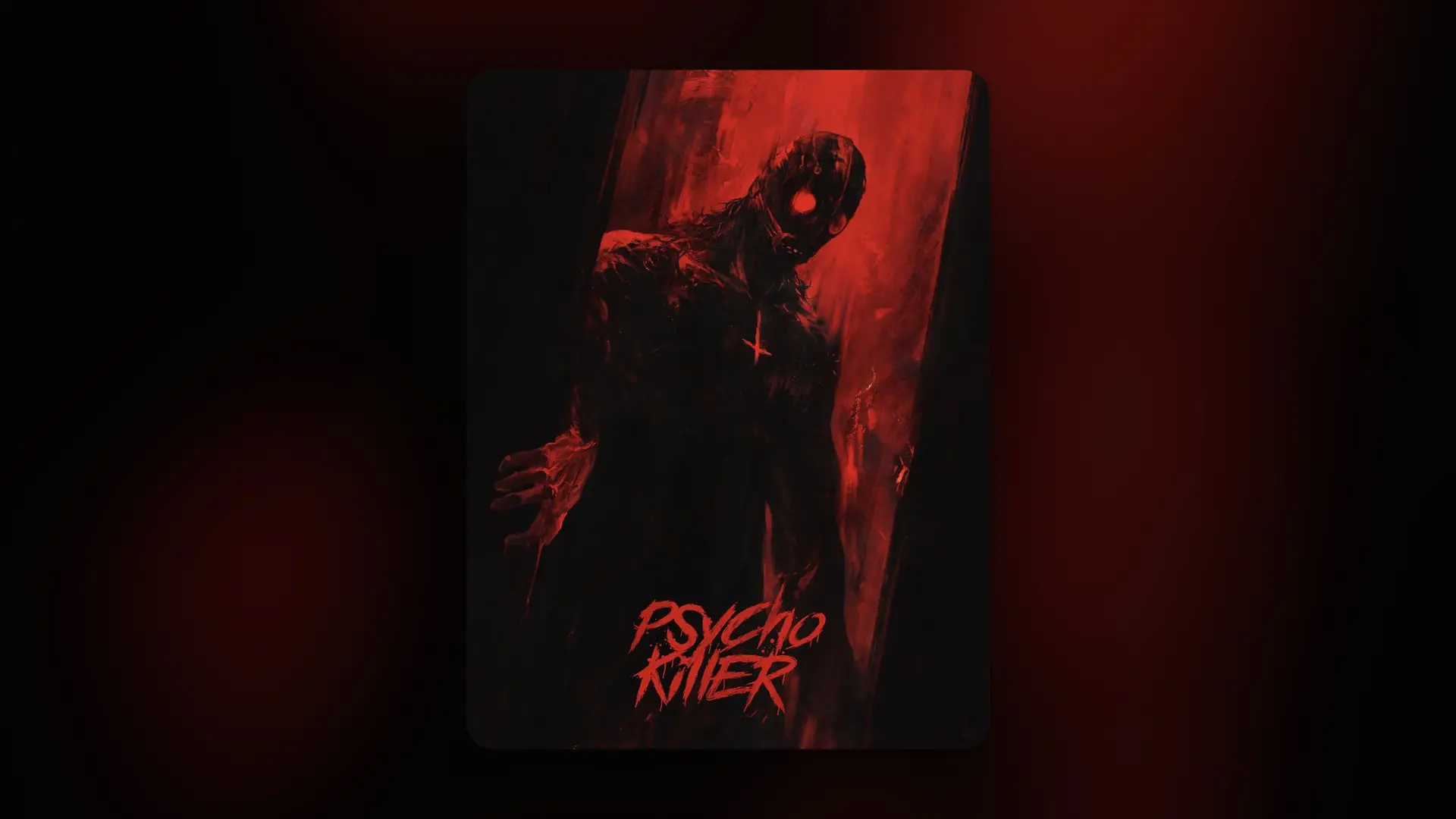
Psycho Killer feels like someone had a good mask and then tried to grow a movie around it in a tray.
That mask gets a star. I am not kidding. The killer design is the one part of the movie that immediately knows what it wants to be: blunt, ugly, readable from the cheap seats, and just theatrical enough to promise a better trash object than the film can actually deliver. Horror can survive a lot on one great face. This one cannot survive entirely on it, but for a few seconds at a time, the mask does real work.
The other star belongs mostly to Roger Fires’s production design. Looking for a silver lining here does not require imagination. The movie has spaces with intent: rooms and industrial corners and serial-killer clutter that suggest a nastier, more coherent object hiding somewhere inside the released cut. It looks cooler than it plays. That is a strange compliment, but still a compliment. There are stretches where the design is carrying more story than the screenplay, which is a bad allocation of labor and also the only thing keeping the film from evaporating.
The photography does not always know how to use what Fires gives it. Sometimes the frame catches the grime and shape of the world. Other times the movie points the camera at a good-looking set with the energy of a surly landlord documenting a security deposit dispute. You can feel visual ideas arriving with nowhere to go. A wall, a corridor, a room full of bad implications. Then dialogue happens, and the air leaves again.
The script is beyond rough. That is the main problem, and it is fatal. Georgina Campbell is handed a grief/revenge arc that should make the movie move. Her husband is murdered. She hunts the killer. The premise should have clean forward pressure. Instead, Jane feels underserved almost immediately, less a person driven by grief than a function dragged through a procedural outline. That’s a massive problem because the film needs Jane to pull against the killer. Without her, Psycho Killer becomes a showcase for a design concept and a collection of serial-killer gestures that have been sitting in storage since a time when Satanic Panic references still felt like appropriate genre signaling. The killer is not frightening enough to dominate the movie, funny enough to become camp, or enchanting enough to become myth. He has the mask, some blood, some occult wallpaper, and the title of the movie pointing at him like a damned name tag.
The title is almost cruel. Psycho Killer is a great dumb title. It promises velocity. It promises grime, threat, bad decisions, maybe even the dignity of a movie willing to embarrass itself in pursuit of a good time tossing popcorn around. Instead, the movie is weirdly forgettable. Not forgettable next week. Forgettable while it is actually happening to you. I kept reaching for the part I was supposed to remember and coming back with the mask, the production design, and a general sense that people had once worked very hard on a version of this that may have made more sense.
That was the most interesting thing we heard around the movie: a hint that what reached screens was substantively less than the movie that was made. I believe that. Psycho Killer has the feeling of a film damaged at several handoff points. Development, production, edit, release, some combination of all of it. The pieces do not simply fail to add up. They look like pieces from different boxes, forced together because the cool mask was already on the poster.
Two stars. One for the mask, one for the production design, and that may be the cleanest accounting I can offer. The rest is a rough-draft serial-killer thriller with a good lead it does not know how to use, a revenge story it cannot make hurt, and a villain who arrives dressed for a better movie.