
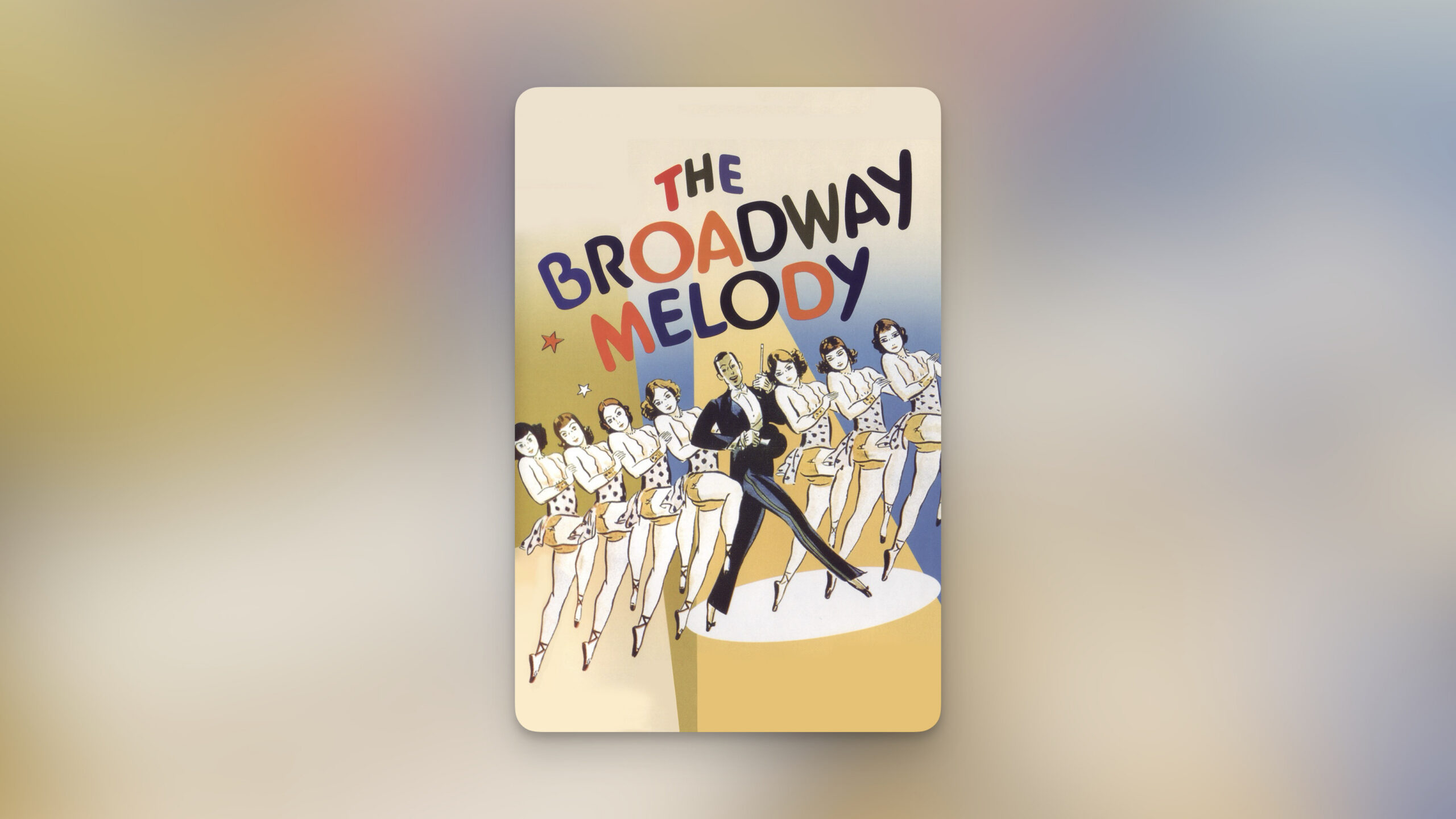
The men in this movie treat the women like furniture that occasionally talks back. I know that comes with the territory when you’re watching a film from 1929, and I try to meet old movies on their own terms, but The Broadway Melody kept pulling me out of itself. Eddie falls for Queenie the moment he sees her and abandons Hank without much apparent guilt. Jock Warriner’s pursuit of Queenie is presented as dangerous but also kind of flattering. The whole system (producers, financiers, boyfriends) handles these women as commodities, and the film doesn’t seem to notice it’s doing it. That’s the period, sure. I still couldn’t stop noticing. “Those guys are not going to pay ten bucks to look at your face; this is Broadway!”
The story underneath all of that is actually worth something. Hank and Queenie Mahoney are a vaudeville sister act trying to make it on Broadway. Hank has the talent; Queenie has the looks. The industry wants Queenie. Eddie, who was supposed to love Hank, wants Queenie. And Hank, who sees all of this happening, who knows she’s being passed over for reasons she can’t compete with, gives them her blessing and walks away alone. The film earns that ending. The problem is that it buries the story under flat staging, the technically primitive sound recording of the period, and a love triangle the camera seems more interested in than the sister relationship that actually matters.
Bessie Love is the reason to sit through this. Her performance as Hank, particularly the breakdown scene where she realizes she’s lost Eddie, operates at a level the rest of the movie can’t reach. She was nominated for Best Actress, and watching her in the middle of all this (the hissing sound, the locked-off camera, Charles King delivering his lines like he’s reading cue cards in a neighboring room), you understand why. She is acting in a better film than the one she’s in.
This was MGM’s first all-talking picture, and every limitation of early sound technology is on display. The camera barely moves because it’s sealed in a soundproof booth to muffle motor noise. Actors project toward hidden microphones. The staging is flat and stagy: a visible regression from Wings, which had cameras strapped to biplanes a year earlier. The musical numbers are shot from a fixed proscenium angle, pointed straight at the stage, no movement, no visual imagination.
The songs from this movie became standards. I can’t get over that. “You Were Meant for Me” was one of the first pop hits to come out of a motion picture. Three of the Brown and Freed songs ended up in Singin’ in the Rain. Arthur Freed leveraged this film into a career as the architect of the MGM musical. All of that legacy, and I watched the performances of these songs in the actual movie and forgot them before the next scene. The songs survived. The film’s versions of them did not.
What does stay with me is the historical accident of timing. This movie premiered on February 1, 1929, at Grauman’s Chinese Theatre. America was still riding the Roaring Twenties. By October, while this film was still playing in theaters, the stock market crashed. The Broadway Melody is a movie about glamour and ambition and showbiz excess that was screening as the economy collapsed underneath it. The filmmakers couldn’t have known. That irony isn’t in the text. But once you know it’s there, it gives the whole thing a weight it can’t manufacture on its own.
I don’t know yet if this is the worst Best Picture winner of all time. I haven’t seen all of them. But it’s one I’ll remember as a candidate. Bessie Love deserved better. The songs deserved better productions. The sister relationship deserved a film that could see it clearly. And the fact that it won Best Picture at all tells you more about what the Academy valued in 1930 (proof that talkies could work) than about the quality of what’s on screen.